
Key Takeaways
- Insurance document automation eliminates the manual processing of high-volume, variable-format documents — replacing hours of data entry with minutes of AI extraction across claims, underwriting, policy administration, and compliance.
- AI can automate at least 10 categories of insurance document, from structured claim forms and policies to unstructured handwritten accident reports and medical records.
- Automated document processing in insurance reduces manual processing time by up to 80%, raises data extraction accuracy above 95%, and removes the seasonal backlogs that peak claim and renewal volumes create.
- Intelligent document processing handles documents regardless of format — scanned PDFs, handwritten forms, digital submissions, and multi-page packages — without predefined templates.
- AgenticSwift AI Document Parser is purpose-built for insurance document automation — with ICR, NLP, zero-template extraction, and enterprise API integration.
Manual document handling is the largest operational bottleneck in insurance. Every claim, every policy, every underwriting submission, every renewal generates documents — arriving in different formats, from different parties, at high and unpredictable volumes. Processing them manually means errors, delays, and costs that compound across thousands of transactions every month.
Insurance document automation using AI changes this fundamentally. Automated document processing in insurance extracts structured data from any document in minutes, validates it against business rules, and delivers it directly to the systems that need it — without manual intervention. In 2026, insurance document processing at scale is an AI function, not a human one.
This guide covers the top 10 insurance documents AI can automate, how the technology works, and what to look for when choosing an intelligent document processing platform for your insurance operation.
Table of Contents
- What Is Insurance Document Automation?
- Why Insurance Companies Are Automating Document Workflows
- How AI Automates Insurance Documents
- Top 10 Insurance Documents That Can Be Automated Using AI
- Benefits of Insurance Document Automation
- AI vs Traditional Insurance Document Processing
- Best Practices for Automating Insurance Documents
- How to Choose an Insurance Document Automation Solution
- Why AgenticSwift AI Document Parser for Insurance?
- Frequently Asked Questions
What Is Insurance Document Automation?
Insurance document automation is the use of artificial intelligence — specifically NLP, OCR, and machine learning — to automatically extract, classify, validate, and route data from insurance documents without manual entry at any stage.
Where manual insurance document processing requires a person to read a document, identify the relevant data fields, type them into a system, and check them for accuracy — AI-powered document automation does all of this automatically, in seconds, on any volume of documents.
Manual vs AI-powered insurance document processing:
- Manual processing: Document arrives, staff reads it, data is typed into system, errors are corrected, document is filed. Time: 15–60 minutes per document. Error rate: 1–4%.
- AI-powered automation: Document is uploaded or received, AI classifies it, NLP extracts all data fields, business rules validate the output, structured data is pushed to downstream systems. Time: under 60 seconds. Accuracy: 95%+.
Why Insurance Companies Are Automating Document Workflows
The case for automated document processing in insurance is built on six operational pain points that every insurer managing volume will recognize:
- Manual data entry: Claims, applications, and policy documents require data entry at every stage. High volume makes manual entry unsustainable without proportional headcount increases.
- Human error rate: A 1–4% error rate on data entry across 10,000 monthly documents produces up to 400 errors — each triggering rework, disputes, or compliance exposure.
- Slow claims processing: Manual document intake is the primary source of claims cycle time delay. Policyholders expect faster resolution than manual processing can deliver.
- Compliance risk: Regulatory documentation requirements change. Manual compliance tracking creates risk every time a regulation updates or a new document type enters the workflow.
- Rising operational costs: Document-intensive processes are staff-intensive. The fully-loaded cost of manual processing — including error correction and rework — is one of the highest per-transaction costs in insurance operations.
Benefits of automating insurance document workflows:
- Faster claims and underwriting approvals — hours reduced to minutes
- Higher data accuracy — AI-assisted extraction above 95% with exception management
- Unlimited scalability — peak volumes processed without backlogs or overtime
- Better policyholder experience — faster decisions mean faster service
How AI Automates Insurance Documents — The Six-Step Workflow
Intelligent document processing for insurance follows a structured automated pipeline. Each step adds a layer of intelligence that manual processing cannot replicate at scale:
| 1 | 2 | 3 | 4 | 5 | 6 |
| Upload | Classify | Extract | Validate | Automate | Integrate |
| Any format | AI identifies type | OCR + NLP | Business rules | Workflow trigger | Push to systems |
- Document upload: Accepts any format — native PDF, scanned PDF, JPEG, TIFF, Word, or email attachment. Batch upload supported for bulk processing.
- AI classification: The AI identifies the document type — claim form, medical record, proof of identity, underwriting submission — without being told, and routes it to the correct extraction workflow.
- Data extraction (OCR + NLP): Optical Character Recognition converts image-based content to text. NLP extracts specific data fields in context — understanding that ‘AstraZeneca’ is a provider name, not a drug, and that a date in one position is an incident date while the same format in another position is a submission date.
- Data validation: Extracted data is checked against business rules, cross-referenced with existing policy records, and flagged if confidence scores fall below the threshold. Exceptions route to human review with the source location highlighted.
- Workflow automation: Validated data triggers downstream workflows automatically — claim creation, underwriting routing, renewal notification, compliance logging — without manual handoffs.
- Integration with insurance systems: Structured data is delivered via API to claims management platforms, policy administration systems, CRMs, ERP, and underwriting tools. No manual copy-paste between systems.
Top 10 Insurance Documents That Can Be Automated Using AI
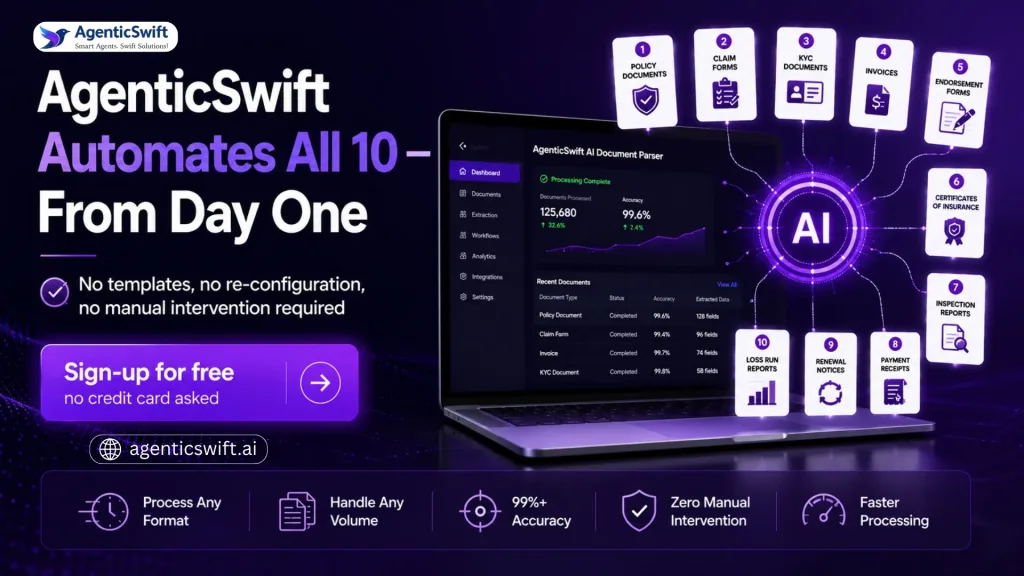
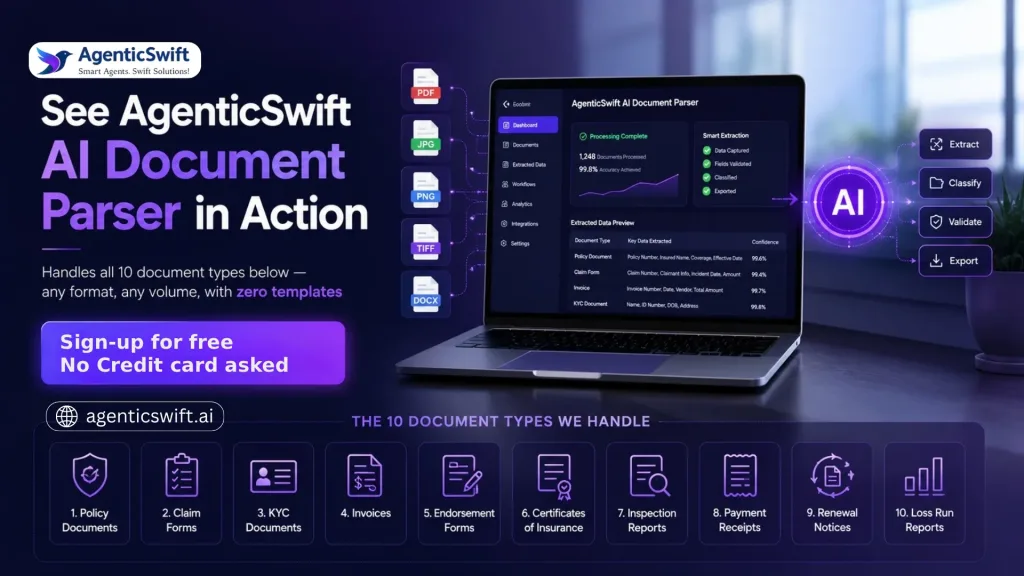
Document automation for insurance applies across every document type in the insurance lifecycle. Here are the 10 highest-volume, highest-impact documents where AI delivers immediate ROI:
1. Insurance Claim Forms
Challenge: Claim forms arrive from policyholders in inconsistent formats — handwritten, digital, multi-page — with variable layouts across different product lines and carriers.
What AI automates: AI extracts claimant details, incident description, policy number, claim type, damage description, and supporting documentation references. Handwritten fields are handled via ICR. FNOL data is populated in the claims management system automatically.
Result: Claims intake drops from hours to minutes. Adjusters receive pre-populated files with all extracted data validated and exceptions flagged.
2. Insurance Policy Documents
Challenge: Policy documents are dense, terminology-specific, and variable in structure across product lines. Manual review for coverage terms, exclusions, and endorsements is slow and inconsistent.
What AI automates: AI extracts coverage limits, exclusion clauses, endorsement details, effective dates, premium amounts, and insured details. Clause-by-clause comparison is performed against standard policy forms. Missing or inconsistent provisions are flagged automatically.
Result: Policy review time reduces from hours to minutes. Coverage gaps and compliance issues are surfaced at issuance, not at claim.
3. Medical Records
Challenge: Medical records for health and life insurance claims are narrative clinical documents — not structured forms. Extracting diagnosis codes, procedure codes, medication details, and treatment dates manually is time-consuming and error-prone.
What AI automates: NLP models trained on clinical terminology extract ICD-10 diagnosis codes, CPT procedure codes, medication names, dosages, provider identifiers, and treatment dates from clinical notes and discharge summaries — without template mapping.
Result: Prior authorisation and claims eligibility decisions are faster. Revenue cycle management errors decrease. Clinical review staff focus on complex cases, not data entry.
4. Proof of Identity Documents
Challenge: KYC compliance requires extraction and validation of identity data from passports, driving licences, and national ID cards — in multiple formats, from multiple countries, with variable layouts.
What AI automates: AI extracts full name, date of birth, document number, expiry date, and issuing authority from any identity document format. Data is cross-referenced against policy application details for consistency. Anomalies are flagged for manual review.
Result: KYC processing is automated end-to-end. Compliance documentation is generated automatically. Onboarding cycle time falls significantly.
5. Accident and Incident Reports
Challenge: Accident reports in auto and property insurance combine structured fields with free-text incident narratives, handwritten annotations, and photographs — making them one of the most complex document types for manual processing.
What AI automates: AI extracts incident date, location, parties involved, vehicle or property details, and witness information from both structured fields and narrative text. NLP identifies liability signals and inconsistency flags within the incident description.
Result: Claims triage is faster. Fraud detection improves as AI identifies narrative inconsistencies that manual review misses. Reserve setting is more accurate with complete incident data at FNOL.
6. Invoices and Medical Bills
Challenge: Medical billing invoices, repair cost estimates, and vendor invoices for insurance claims arrive in hundreds of different formats from different providers. Manual extraction is a major claims processing bottleneck.
What AI automates: AI extracts provider name, service codes, line item amounts, totals, dates, patient or vehicle identifiers, and tax details from any invoice format. Bill amounts are cross-referenced against policy coverage limits and pre-authorised amounts automatically.
Result: Invoice processing cycle time drops from days to hours. Over-billing and duplicate billing are caught automatically before payment is approved.
7. Underwriting Submission Documents
Challenge: Commercial underwriting submissions arrive from brokers as unstructured PDF packages containing applications, loss runs, financials, and supplemental questionnaires in different formats from different submitters.
What AI automates: AI extracts key risk parameters from every document in the submission package simultaneously — business description, revenue, loss history, coverage requested, and risk modifiers — and structures them into a standardized underwriting data format.
Result: Submission-to-quote time drops from days to hours. Underwriters receive structured risk data rather than raw document packages, freeing time for risk judgment rather than data assembly.
8. Insurance Agreements and Contracts
Challenge: Reinsurance agreements, broker contracts, vendor agreements, and specialty policy contracts are long, terminology-dense documents with critical dates, obligations, and financial terms buried in legal language.
What AI automates: AI extracts party names, effective dates, termination notice periods, coverage limits, commission structures, reporting obligations, and auto-renewal clauses. Clause-by-clause comparison is performed against standard agreement templates.
Result: Contract renewal dates no longer trigger unintentionally. Obligation tracking is automated. Legal team review time is redirected from reading to risk assessment.
9. Loss Run Reports
Challenge: Loss run reports — required for commercial insurance underwriting — arrive from previous insurers in non-standard formats and must be manually extracted into a comparable structure for risk assessment.
What AI automates: AI extracts claim dates, claim types, amounts paid, amounts reserved, open or closed status, and policy period for every loss entry across any loss run format. Data is normalised into a standardised loss table regardless of source format.
Result: Commercial underwriting submissions are processed faster. Loss history analysis that previously required manual re-entry is automated, improving risk assessment accuracy and pricing precision.
10. Policy Renewal Documents
Challenge: Renewal packages sent to policyholders and renewal submissions from brokers must be processed, compared against the expiring policy, and actioned — at high volumes during renewal cycles, creating seasonal processing bottlenecks.
What AI automates: AI extracts renewal terms, premium changes, coverage modifications, and endorsement additions. Comparison against the expiring policy is performed automatically, with material changes flagged for underwriter or account manager review.
Result: Renewal cycle processing is automated end-to-end for standard renewals. Lapse rates fall as renewal communications are triggered earlier and more accurately. Underwriter time is freed for complex renewals requiring judgment.
Benefits of Insurance Document Automation
Deploying insurance document automation across these ten document types delivers compounding operational improvements across the entire policy lifecycle:
- Faster claims: Claim document intake that previously took 4–8 hours completes in under 15 minutes. First reserve is set faster. Settlement cycle is accelerated.
- Higher accuracy: AI extraction at 95%+ accuracy with exception management consistently outperforms the 1–4% manual error rate on high-volume, repetitive document types.
- Reduced operational costs: Cost per document processed falls significantly as volume scales. Peak periods — renewal cycles, catastrophe events — are handled without overtime or outsourcing.
- Automated compliance: Every document is checked against regulatory requirements relevant to that document type and jurisdiction. Full audit trail generated automatically on every transaction.
- Fraud detection: AI cross-references extracted data across multiple documents — claim form versus medical record versus accident report — surfacing inconsistencies that manual review catches inconsistently or too late.
- Improved customer satisfaction: Faster document processing means faster decisions, faster payments, and more responsive service — directly improving NPS and retention metrics.
- Increased productivity: Staff previously dedicated to document data entry are reallocated to higher-value work. Adjuster, underwriter, and compliance team capacity increases without hiring.
AI vs Traditional Insurance Document Processing
The difference between traditional OCR-based document processing and AI-powered insurance document automation determines whether your solution can handle real-world insurance documents at production volume:
| Factor | Traditional Processing | AI Document Automation |
| Processing speed | Hours to days per document | Minutes — automated extraction |
| Data accuracy | 1–4% human error rate | 95%+ AI extraction accuracy |
| Document volume | Bottlenecks at peak periods | No volume ceiling |
| Consistency | Varies by reviewer and document type | Same logic applied to every document |
| Compliance | Manual tracking, frequent gaps | Automated validation, full audit trail |
| Fraud signals | Missed without manual cross-referencing | AI flags anomalies in real time |
| Cost per document | High — labour-intensive | Fraction of manual cost at scale |
| Handwritten content | Requires manual transcription | Handled via Intelligent Character Recognition |
Best Practices for Automating Insurance Documents
Organisations that successfully automate insurance document workflows follow five consistent practices that separate successful deployments from expensive proof-of-concepts:
- Choose an AI platform, not an OCR tool: Basic OCR requires templates for every document layout. AI-powered intelligent document processing handles variable layouts without configuration. Validate this distinction with your own documents before committing to a vendor.
- Start with high-volume, high-cost documents: Claim forms, medical records, and underwriting submissions represent the highest volume and highest cost of manual processing. Automate these first for the fastest demonstrable ROI.
- Integrate with existing systems first: Extracted data has no value unless it reaches the systems that need it. Confirm API integration with your claims platform, policy administration system, and CRM before deployment, not after.
- Validate extracted data before going live: Run the AI on a representative sample of your real documents before production. Measure extraction accuracy by field type and document type. Configure confidence thresholds and exception routing appropriately.
- Monitor AI performance continuously: Model accuracy can drift as document formats evolve. Build performance monitoring into the deployment — track extraction accuracy, exception rates, and processing volumes — and schedule retraining cycles as needed.
How to Choose an Insurance Document Automation Solution
Evaluating intelligent document processing for insurance requires assessing eight critical capabilities. Every item below is a production requirement — not a differentiator.
Evaluation Checklist — Insurance Document Automation Vendors
✔ Accuracy — extraction accuracy above 95% on your specific document types, not on benchmark datasets
✔ ICR capabilities — Intelligent Character Recognition for handwritten content, mixed print-and-handwriting documents
✔ Security — data encryption at rest and in transit, role-based access, SOC 2 alignment, configurable data residency
✔ Compliance — audit logging on every extraction, configurable validation rules by jurisdiction and document type
✔ API integrations — documented APIs and pre-built connectors for claims, policy admin, CRM, and ERP systems
✔ Scalability — no volume ceiling, performance maintained under peak load, pricing that scales with usage not seats
✔ Deployment model — cloud, on-premise, or hybrid deployment options matching your data residency requirements
✔ Vendor support — implementation support, model retraining, ongoing maintenance, and SLA-backed uptime commitments
Why AgenticSwift AI Document Parser for Insurance?
AgenticSwift AI Document Parser is a purpose-built insurance document automation platform — not a generic document tool adapted for insurance. Every capability is designed for the document types, accuracy requirements, and system integration needs of production insurance operations.
- AI-powered Intelligent Character Recognition (ICR): Reads handwritten content, mixed document formats, and low-resolution scans that basic OCR misreads — critical for claim forms, accident reports, and legacy policy documents.
- Processes structured and unstructured documents: Handles form-based documents, narrative clinical notes, legal contracts, and image-heavy submissions — any document your insurance operation receives, in any format.
- No template-based extraction: A new broker submission layout or a new carrier’s claim form is read correctly on the first pass. Zero re-configuration required for new document sources or format updates.
- Enterprise-ready security: SOC 2-aligned security with data encryption, role-based access control, full audit logging on every extraction, and configurable data residency for regulatory compliance.
- Easy API integration: Well-documented REST API and pre-built connectors for common insurance platforms. Connects to your claims management system, policy admin, CRM, and ERP without replacing existing infrastructure.
- High extraction accuracy: Trained on insurance-specific document types and policy language — consistently achieving above 95% field-level accuracy on well-represented document types in production.
- Fast implementation: Production deployment in weeks, not months. No lengthy template-building phase. Immediate accuracy on your document types from the first batch.
- Scalable for insurers of all sizes: From independent agencies processing hundreds of documents monthly to national carriers processing millions — AgenticSwift scales without volume ceilings or per-document pricing cliffs.
Frequently Asked Questions
What is insurance document automation?
Insurance document automation uses AI — specifically OCR, NLP, and machine learning — to extract, classify, validate, and route data from insurance documents automatically. It replaces manual data entry with automated processing across claim forms, policy documents, medical records, underwriting submissions, and other insurance document types.
How does AI automate insurance documents?
AI automates insurance documents through a six-step pipeline: document upload, AI classification by document type, OCR and NLP data extraction, business rule validation, workflow automation, and API delivery to downstream systems. The process runs in under 60 seconds per document without manual intervention at any stage.
What insurance documents can AI process?
AI can process claim forms, insurance policies, medical records, proof of identity, accident reports, invoices and bills, underwriting submissions, contracts and agreements, loss run reports, and renewal documents. These cover every major document type across claims, underwriting, policy administration, and compliance workflows.
What is intelligent document processing for insurance?
Intelligent document processing for insurance is an AI-powered system that goes beyond basic OCR. It understands the content and context of insurance documents — identifying clause types, extracting domain-specific entities, detecting missing provisions, and making decisions based on business rules — without requiring a template for every document layout.
Can AI extract data from handwritten insurance forms?
Yes. AI systems with Intelligent Character Recognition (ICR) capability extract data from handwritten fields, mixed print-and-handwritten documents, and degraded scans. AgenticSwift AI Document Parser includes ICR specifically to handle the handwritten claim forms, accident reports, and legacy documents common in insurance operations.
Is insurance document automation secure?
Enterprise insurance document automation operates with data encryption in transit and at rest, role-based access control, full audit logging on every extraction, and configurable data residency. AgenticSwift deployments are SOC 2-aligned. Documents never leave your secure environment without explicit authorisation.
How accurate is AI document processing?
AI document processing systems trained on insurance-specific documents consistently achieve above 95% field-level extraction accuracy on well-represented document types. Low-confidence extractions are flagged for human review rather than passed through incorrectly — ensuring the net accuracy of AI-assisted workflows exceeds pure manual processing.
What are the benefits of automating insurance document workflows?
Faster processing (hours to minutes), higher accuracy (95%+ vs 1–4% manual error rate), unlimited scalability without headcount increases, automated compliance documentation, real-time fraud signal detection, reduced operational cost per document, and improved customer experience through faster decisions and settlements.
Can AI integrate with existing insurance management systems?
Yes. AI document automation platforms connect to existing claims management systems, policy administration platforms, CRM, underwriting tools, and ERP via REST API. AgenticSwift provides pre-built connectors for common insurance platforms and custom API development for proprietary systems — no system replacement required.
Which insurance companies benefit most from document automation?
Any insurer processing high volumes of variable-format documents benefits from automation. The highest ROI is seen in carriers with large claims volumes, commercial lines insurers managing complex underwriting submissions, health insurers processing medical records and prior authorizations, and agencies handling renewal and onboarding document volumes across multiple carrier systems.
Conclusion
Insurance document automation is not a future investment — it is an operational necessity for any insurer processing volume in 2026. The ten document types in this guide represent the highest-cost, highest-volume manual processing in insurance operations today. Automating them with AI delivers measurable improvements in claims speed, underwriting efficiency, compliance coverage, and operational cost — simultaneously.
The right intelligent document processing platform makes the difference between a deployment that delivers production ROI and one that delivers a proof-of-concept. The evaluation checklist in this guide gives you the framework to make that distinction during vendor selection.
AgenticSwift AI Document Parser is built for exactly this: enterprise-grade insurance document automation that works on your documents, integrates with your systems, and scales with your operation from day one.