
Key Takeaways
- Insurance document automation uses AI to extract, process, and generate policy documents, claims, and compliance records without manual input.
- Intelligent document processing for insurance reduces processing time significantly and cuts operational costs across the board.
- Automated document extraction in insurance handles unstructured data including PDFs, scanned forms, and emails with high accuracy.
- Use cases span claims processing, underwriting, policy issuance, compliance reporting, and health insurance document automation.
- nsurers that automate document workflows gain faster turnaround, fewer errors, and stronger audit trails.
Introduction
Insurance runs on documents. Policies, claims, endorsements, compliance filings, medical records, client correspondence. The volume is relentless and the margin for error is zero.
Yet most insurance organizations still process a large share of this paperwork manually. Staff key in data from PDFs, reconcile information across disconnected systems, and chase missing fields before a claim can move forward. The result is slow cycle times, high processing costs, and a customer experience that frustrates at every touchpoint.
Insurance document automation changes that equation. By combining AI, machine learning, and workflow automation, insurers can extract, validate, process, and generate documents at scale with accuracy and speed no manual process can match.
What Is Insurance Document Automation?
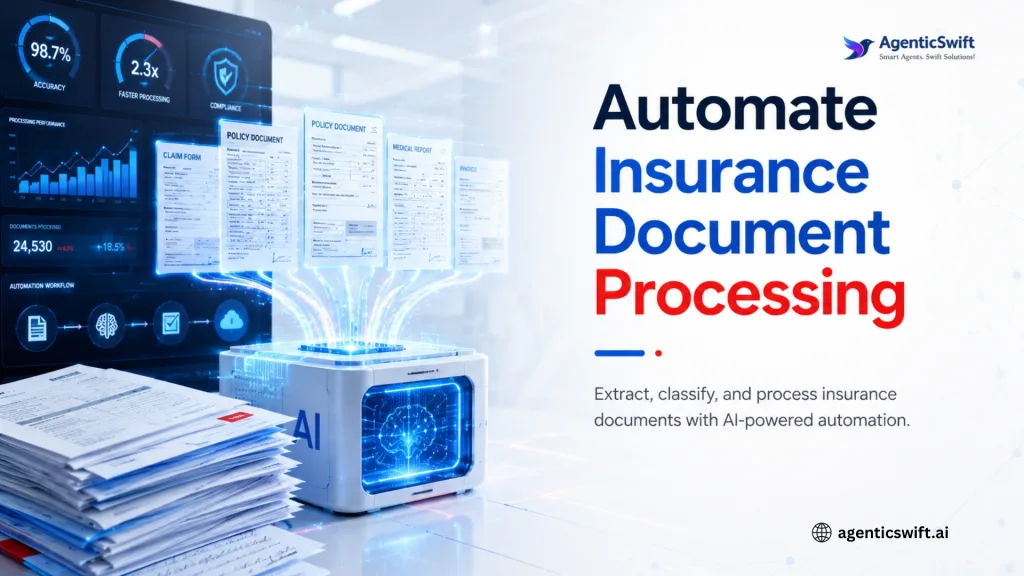
Insurance document automation is the use of artificial intelligence and workflow technology to handle the creation, extraction, classification, and processing of insurance documents without manual intervention. It covers two distinct but related functions.
Document Extraction and Processing
Automatically reading incoming documents such as claims forms, medical reports, policy applications, and ID proofs, then pulling structured data from them regardless of format or layout. This is what most people refer to as automated document processing in insurance.
Insurance Document Generation and Production
Automatically creating outgoing documents including policy certificates, renewal notices, endorsement letters, and compliance reports based on data already held in your systems. This is insurance document production at scale.
Intelligent document processing for insurance goes further than basic automation. Rather than relying on fixed templates or rigid rules, IDP uses machine learning to understand document context, identify relevant fields, and handle variation across formats including handwritten forms, scanned PDFs, and multi-language agreements. Intelligent document processing insurance agreements and documentation is where this capability becomes a genuine operational differentiator.
How Insurance Document Automation Works
A complete insurance document automation system operates across four stages:
Stage 1: Ingestion
Documents arrive from multiple channels including email attachments, portal uploads, scanned mail, and third-party integrations. The system ingests all formats including PDFs, images, Word files, structured forms, and unstructured text.
Stage 2: Classification
The AI classifies each document by type including claims forms, medical reports, policy applications, ID documents, and legal agreements. This determines which extraction rules and workflow steps apply.
Stage 3: Extraction and Validation
Automated document extraction in insurance pulls the relevant data fields including policyholder name, claim number, date of loss, coverage details, and medical codes. These are validated against existing records or business rules. Exceptions are flagged for human review while clean records move forward automatically.
Stage 4: Processing and Output
Extracted data feeds downstream workflows including claims adjudication, underwriting decisions, and policy issuance. It can also trigger insurance document generation, producing the required output document, routing it for approval if needed, and delivering it to the right recipient. This end-to-end flow is what makes it possible to automate insurance document workflows at scale across lines of business without rebuilding core systems.
Key Benefits of Insurance Document Automation
Faster Processing Cycles
Manual document processing in insurance can take days. Automated pipelines compress the same work to minutes. Claims get adjudicated faster, policies get issued sooner, and renewals go out on time without adding headcount.
Higher Accuracy and Fewer Errors
Human data entry introduces errors. Intelligent document processing for insurance catches inconsistencies, validates against policy data, and flags anomalies before they reach downstream systems, reducing rework and compliance exposure.
Significant Cost Reduction
Automating insurance document workflows eliminates the per-document labor cost that accumulates across high-volume operations. The ROI compounds as processing volume grows.
Audit-Ready Compliance
Every extraction, validation, and processing action is logged. Insurers gain a complete, timestamped audit trail for every document, which is critical for regulatory reporting and dispute resolution.
Better Customer Experience
Faster claims settlement. Instant policy documents. Accurate correspondence. Automated insurance document production directly improves the touchpoints customers notice most.
Scalability Without Proportional Cost
When claim volumes spike after a weather event or renewal volumes peak at year-end, automated document processing for insurance scales without the hiring lag that breaks manual operations.
Real-World Use Cases of Document Automation for Insurance
Claims Processing
The highest-volume use case. Insurance data extraction pulls loss details, coverage information, and supporting evidence from claims submissions, reducing the time from first notice of loss to settlement decision.
Underwriting Documentation
Underwriters deal with complex application packages including financial statements, inspection reports, and prior claims history. Automated document extraction in insurance pulls the relevant signals automatically so underwriters spend time on judgment, not data entry.
Policy Issuance and Endorsements
Insurance document generation automates the production of policy certificates, schedule pages, and endorsement letters based on data already in the policy admin system, eliminating manual drafting entirely.
Health Insurance Document Automation
Health insurers handle a high volume of clinical documents including EOBs, medical records, prior authorization forms, and provider agreements. Health insurance document automation processes these at scale, reducing administrative burden and improving claims accuracy.
Compliance and Regulatory Reporting
Regulatory filings require consistent, accurate data pulled from multiple source documents. Document automation for insurance handles the aggregation, formatting, and audit trail, reducing compliance risk significantly.
Intelligent Document Processing for Insurance Agreements
Complex legal agreements including reinsurance contracts, broker agreements, and coverage schedules require intelligent document processing insurance agreements and documentation capabilities that understand context and clause-level structure, not just field positions.
What to Look for in an Insurance Document Automation Solution
When evaluating document automation insurance platforms, these are the capabilities that separate robust production systems from fragile pilots:
- Multi-format ingestion: PDFs, scanned images, emails, and structured forms handled without manual pre-processing.
- Pre-trained insurance models: extraction models already trained on insurance-specific document types reduce implementation time and improve out-of-box accuracy.
- Integration with core systems: connects to your policy admin, claims management, and CRM platforms without requiring a full system replacement.
- Human-in-the-loop workflows: low-confidence extractions route to human review automatically rather than disappearing into an error queue.
- Audit logging and compliance controls: every document action tracked, timestamped, and reportable.
- Scalability: architecture built to handle peak volumes without degrading performance or accuracy.

Frequently Asked Questions
What is insurance document automation?
Insurance document automation is the use of AI and workflow technology to automatically extract data from incoming insurance documents and generate outgoing ones. It replaces manual processing across claims, underwriting, policy issuance, and compliance workflows.
How is intelligent document processing different from OCR?
OCR converts scanned images to text. Intelligent document processing for insurance goes further by understanding document structure, classifying document types, extracting specific fields in context, validating the data, and routing it to downstream workflows. It handles format variation and learns from corrections in a way basic OCR cannot.
What types of insurance documents can be automated?
Claims forms, policy applications, endorsements, renewal notices, medical records, prior authorization forms, reinsurance agreements, compliance filings, broker correspondence, and payment records can all be brought into an automated document workflow.
Is health insurance document automation different from general insurance automation?
In scope, yes. Health insurance document automation deals with a higher volume of clinical documents including EOBs, medical necessity reviews, and provider agreements, and often requires integration with healthcare-specific data standards. The underlying automation principles are the same but the document models and integration requirements differ.
How long does it take to implement document automation for insurance?
A focused implementation on a single document type can go live in four to eight weeks. Enterprise-wide deployment across multiple lines of business typically runs three to six months depending on system complexity and integration requirements.
Does insurance document automation require replacing existing systems?
No. The right solution integrates with your existing policy admin, claims, and CRM platforms via APIs, acting as an automation layer on top of current infrastructure rather than a replacement for it.
How accurate is automated document extraction in insurance?
Well-implemented intelligent document processing systems consistently achieve extraction accuracy above 95% on clean documents. Exception handling routes low-confidence extractions for human review automatically, so overall workflow accuracy is maintained without checking every record manually.
Ready to Automate Your Insurance Document Workflows?
Your document volumes are not going down. The question is how much of that processing you still want to handle manually.
Insurance document automation eliminates the extraction errors, processing delays, and compliance risks that come with manual workflows at every stage of the policy and claims lifecycle. Whether you need intelligent document processing for incoming claims, automated insurance document production for outgoing policies, or end-to-end document automation for insurance across your entire operation, AgenticSwift builds the solution around your systems and your data.