
Key Takeaways:
- Data engineering services build the clean, reliable, well-governed data foundation that every AI and machine learning model depends on.
- MLOps services operationalize models — automating deployment, monitoring, and retraining, so AI keeps performing in production, not just in a notebook.
- Roughly 87–90% of ML models never reach production (VentureBeat, 2019) — a gap driven by infrastructure and processes, not algorithms.
- Together, data engineering and MLOps services turn one-off experiments into scalable data pipelines and MLOps solutions that compound business value.
- The global MLOps market is projected to surpass ~$21 billion in 2026 (industry estimates), reflecting how central this discipline has become to enterprise AI.
Every successful AI initiative rests on two often-overlooked pillars: the data that feeds it and the operational discipline that keeps it running. This is exactly where data engineering & MLOps services come in. One prepares trustworthy, production-grade data; the other turns trained models into living systems that deliver value day after day. Yet most organisations still struggle to cross the gap between a promising prototype and dependable AI infrastructure solutions. Research widely cited from VentureBeat found that nearly 87–90% of machine learning models never make it into production — and the cause is rarely the algorithm. It is the missing pipeline, the absent monitoring, and the lack of repeatable ML workflow automation.
At AgenticSwift, our data engineering and MLOps services for enterprises are designed to close that gap. This guide explains what these disciplines are, why they matter, and how the right data engineering solutions and end-to-end MLOps implementation services unlock scalable, measurable business growth.
What Is Data Engineering in AI?
Data engineering in AI is the practice of designing, building, and maintaining the systems that collect, store, transform, and deliver data so it is ready for machine learning. It covers ingestion from source systems, cleaning and validation, transformation (ETL/ELT), and the architecture that moves data reliably at scale. Strong data engineering services ensure models are trained on accurate, consistent, well-governed data — because even the most advanced model fails when fed unreliable inputs. In short, data engineering is the foundation on which every dependable AI system is built.
What Is MLOps?
MLOps — short for machine learning operations — is the set of practices that take an ML model from development into reliable, repeatable production. It applies DevOps principles to the machine learning lifecycle: version control for data and models, automated testing, continuous deployment, monitoring for drift, and automated retraining. Mature MLOps services make model deployment predictable rather than heroic, so teams ship faster and maintain performance over time. Where data engineering prepares the fuel, MLOps keeps the engine running smoothly in the real world.
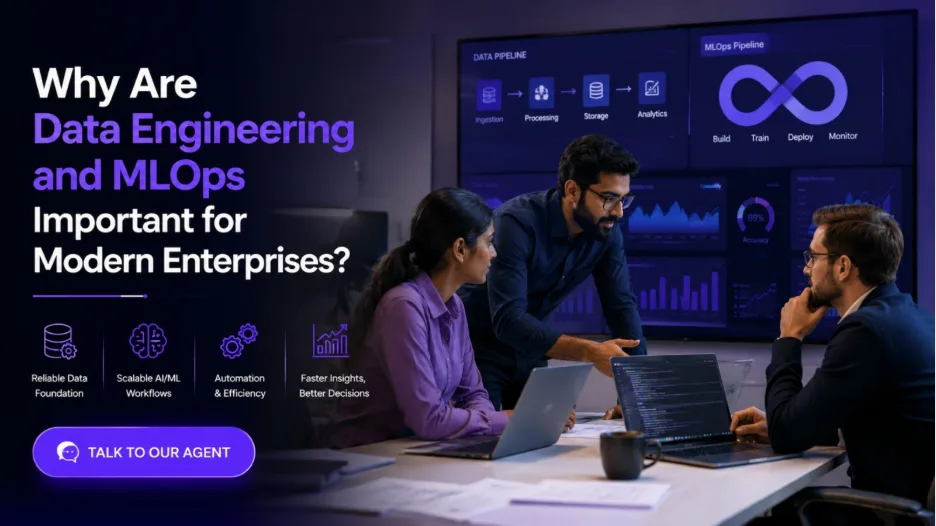
Why Are Data Engineering and MLOps Important for Modern Enterprises?
The business case is stark. Beyond the 87–90% of models that stall before deployment, a 2025 MIT report covered by Fortune found that around 95% of generative AI pilots fail to deliver measurable returns. Gartner has similarly noted that only about half of AI projects move from pilot to production. The common thread is operational immaturity — not data science talent.
Robust data engineering solutions and disciplined machine learning operations directly address this. They reduce time-to-production, lower the cost of maintaining models, improve compliance and auditability, and make AI outcomes repeatable. For decision-makers, that translates into faster ROI, fewer stalled initiatives, and AI infrastructure solutions that scale with the business instead of breaking under it.
Core Data Engineering Services That Power AI
Effective cloud-based data engineering services span the full journey from raw source to model-ready dataset. The most impactful capabilities include:
Data Pipeline Development and Automation
Data pipeline development builds the connective tissue that moves data between systems, while data pipeline automation removes the manual, error-prone steps that slow teams down. Automated pipelines validate data quality, handle schema changes gracefully, and guarantee that fresh, trustworthy data flows into your models continuously — a prerequisite for any serious AI program.
Cloud Data Engineering and Scalable Architecture
Cloud data engineering leverages elastic cloud platforms to store and process data at scale without heavy upfront infrastructure. Well-architected cloud pipelines support batch and real-time workloads, optimise cost, and provide the elasticity needed for scalable data pipeline and MLOps solutions. This is where many enterprises see the fastest gains: replacing brittle, on-premise scripts with resilient, observable cloud-native data flows.
End-to-End MLOps Services and ML Workflow Automation
Once data is flowing reliably, end-to-end MLOps implementation services operationalise the models that depend on it. Comprehensive MLOps consulting covers the entire lifecycle rather than a single stage.
From Model Development to Production Deployment
Strong ML workflow automation connects experimentation to deployment through reproducible pipelines: versioned datasets and models, automated training, validation gates, and continuous delivery. This eliminates the fragile handoffs that cause so many models to stall, turning deployment into a routine, low-risk event.
Monitoring, Governance, and Automated Retraining
Models degrade as the world changes — a phenomenon known as model drift. Mature MLOps continuously monitors performance, data quality, and bias, then triggers AI data engineering and ML workflow automation to retrain when accuracy slips. Built-in governance and audit trails also help organisations meet rising regulatory expectations, making AI both reliable and defensible.
What Are the Benefits of MLOps Services?
Investing in mature MLOps delivers compounding, measurable advantages:
- Faster time-to-production — automated pipelines turn months of deployment work into repeatable, days-long cycles.
- Sustained model accuracy — continuous monitoring and retraining prevent silent performance decay.
- Lower operational cost — standardised workflows reduce manual effort and infrastructure waste.
- Stronger governance — versioning and audit trails support compliance and risk management.
- Scalability — the same framework supports one model or one hundred, enabling true enterprise growth.
Which Industries Benefit from Data Engineering and MLOps?
Almost every data-rich sector benefits, but the impact is greatest where decisions are frequent, high-volume, or time-sensitive. Insurance and financial services use these capabilities for fraud detection, underwriting, and risk scoring; healthcare for diagnostics and patient-risk models; retail and e-commerce for personalisation and demand forecasting; and manufacturing and logistics for predictive maintenance and supply-chain optimisation. Wherever models inform real decisions, reliable data engineering and MLOps services for enterprises are what keep those decisions accurate at scale.
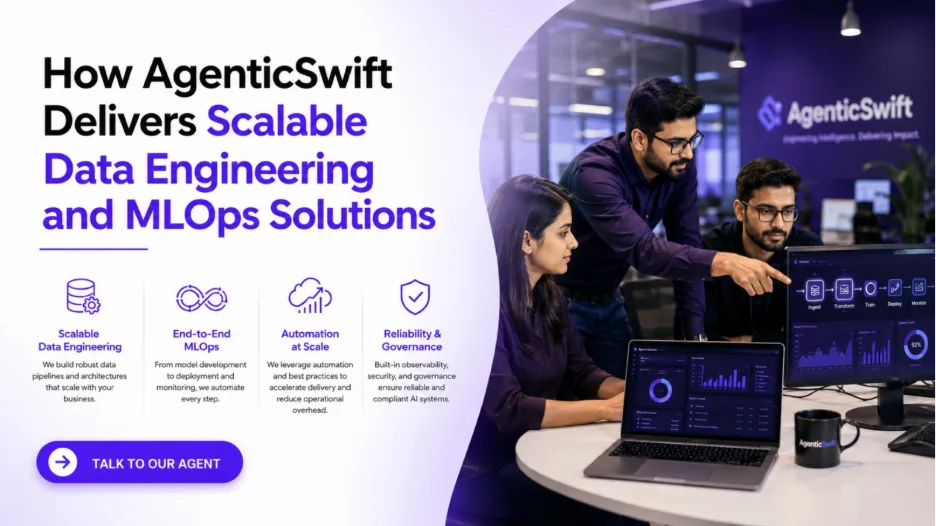
How AgenticSwift Delivers Scalable Data Engineering and MLOps Solutions
AgenticSwift AI partners with enterprises to design, build, and operate the full stack — from custom AI and ML solutions to the data engineering and MLOps backbone that keeps them running. Our teams combine cloud data engineering, automated pipelines, and end-to-end MLOps implementation services to move your models from prototype to dependable production, with the monitoring and governance built in from day one.
Ready to turn stalled experiments into production-grade AI? Talk to the AgenticSwift team about data engineering and MLOps services built for scale. We will assess your data infrastructure, identify the gaps holding your models back, and deliver scalable data pipeline and MLOps solutions that drive measurable business growth. Book your free consultation today.
Frequently Asked Questions
What is data engineering in AI?
Data engineering in AI is the discipline of building and maintaining the systems that collect, clean, transform, and deliver data for machine learning. It ensures models are trained and run on accurate, consistent, well-governed data. Without solid data engineering services, even advanced models produce unreliable results, which is why it forms the foundation of any dependable AI program.
What is MLOps?
MLOps (machine learning operations) is the set of practices that take ML models from development into reliable production. It applies DevOps principles — version control, automated testing, continuous deployment, monitoring, and retraining — to the machine learning lifecycle. MLOps services make model deployment repeatable and keep models accurate over time as data changes.
Why are data engineering and MLOps important?
They close the gap between AI prototypes and production. Studies suggest 87–90% of ML models never reach production, largely due to weak infrastructure and process rather than poor algorithms. Together, data engineering and machine learning operations reduce time-to-production, sustain accuracy, lower cost, and make AI outcomes repeatable and compliant.
What are the benefits of MLOps services?
Key benefits include faster time-to-production, sustained model accuracy through continuous monitoring and retraining, lower operational cost via ML workflow automation, stronger governance and auditability, and scalability across many models. In short, MLOps services turn one-off experiments into reliable systems that compound business value.
Which industries benefit from data engineering and MLOps?
Data-rich, decision-intensive industries benefit most — insurance and financial services (fraud detection, underwriting), healthcare (diagnostics, risk models), retail and e-commerce (personalisation, forecasting), and manufacturing and logistics (predictive maintenance). Any sector where models inform frequent, high-volume decisions gains from reliable data engineering and MLOps services for enterprises.