
AI-Powered ICR for Insurance Claims: The Complete Guide
Insurance claims still arrive the way they did decades ago — on paper, in scrawled handwriting, faxed, scanned, or snapped with a smartphone. Behind every claim sits a stack of forms that someone must read, interpret, and key into a system. It’s slow, it’s expensive, and it’s the single biggest bottleneck in the modern claim’s lifecycle.
This is precisely where AI-powered ICR in insurance is changing the game. Intelligent Character Recognition, supercharged by deep learning, can now read cursive handwriting, messy block letters, and form fields that would stump even human clerks — turning days of manual data entry into seconds of automated extraction.
If your organization is still drowning in handwritten ACORD forms, FNOLs, medical claim sheets, or accident reports, this guide will walk you through everything you need to know about intelligent character recognition in insurance and how it’s reshaping claims operations in 2026.
What is ICR and Why Does It Matter for Insurance?
Intelligent Character Recognition (ICR) is an advanced form of document recognition technology that reads handwritten characters — not just printed text. While traditional OCR (Optical Character Recognition) works reliably on typed documents, it fails on the messy, varied handwriting that dominates real-world insurance paperwork.
Modern ICR technology for insurance uses deep neural networks trained on millions of handwriting samples. These models learn the subtle patterns of how people write — slanted strokes, connected letters, crossed sevens, European-style ones — and convert them into structured, machine-readable data.
ICR vs. OCR: The Critical Difference for Insurers
| Capability | OCR | AI-Powered ICR |
| Printed text | ✓ Excellent | ✓ Excellent |
| Handwritten block letters | Limited | ✓ Excellent |
| Cursive handwriting | Poor | ✓ Strong |
| Checkbox & form field detection | Basic | ✓ Context-aware |
| Signature zones | No | ✓ Yes |
| Contextual understanding | No | ✓ Yes (with NLP) |
For insurers, this difference isn’t academic — it’s the line between 40% and 95% straight-through processing rates.
The Handwritten Insurance Forms Problem
Despite two decades of digital transformation, the insurance industry still processes an enormous volume of handwritten paperwork:
- First Notice of Loss (FNOL) forms filled out at accident scenes
- Health claim forms completed in clinics and hospitals
- Motor accident reports from drivers and witnesses
- Property damage assessments from field adjusters
- Agent applications and proposal forms
- Beneficiary nomination forms
Traditional handwritten insurance forms processing relies on armies of data-entry staff, often offshored, who manually transcribe these forms into core systems. The process is:
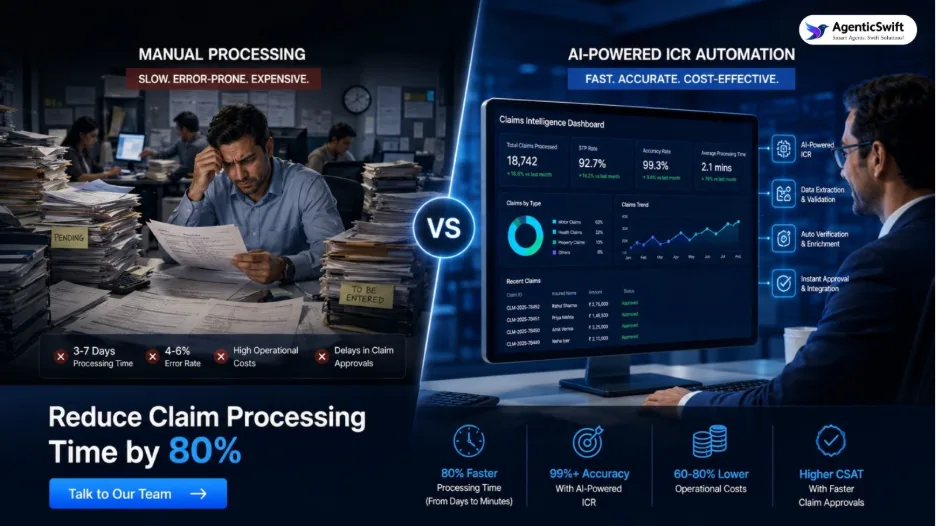
- Slow — average 3 to 7 days per complex claim packet
- Expensive — labor costs of $3 to $8 per form processed
- Error-prone — human transcription error rates of 4% to 6%
- Inconsistent — quality varies by operator, shift, and fatigue
This is the operational reality that AI ICR document processing is built to eliminate.
How AI-Powered ICR Works in Insurance Claims
The modern ICR pipeline for insurance is a multi-stage AI system, not a single algorithm. Here’s what happens under the hood when a claim document enters an AI ICR for handwritten insurance claims platform:
1. Image Pre-processing
Claim documents arrive as scans, mobile photos, or faxes — often skewed, shadowed, or low-resolution. Computer vision models deskew, denoise, binarize, and enhance the image so downstream recognition is reliable.
2. Layout & Form Understanding
Deep learning models identify the document type (Is this an ACORD 25? A CMS-1500? A custom motor claim form?) and locate each field — name, policy number, date of loss, claim amount, signature zones, checkboxes.
3. Handwriting Recognition
This is the core ICR step. Transformer-based or CRNN (Convolutional Recurrent Neural Network) models convert each handwritten field into text. Modern systems handle multiple languages, mixed cursive-and-print writing, and domain-specific vocabulary like medical codes or policy numbers.
4. Contextual Validation
AI cross-checks extracted values against business rules and context. A policy number that doesn’t match the insurer’s format is flagged. A claim date in the future is escalated. This contextual layer is what separates AI ICR document processing from legacy recognition tools.
5. Human-in-the-Loop Review
Low-confidence fields are routed to human reviewers through a streamlined interface. These corrections feed back into the model, making the system more accurate over time — especially for your specific forms and customer base.
6. Integration with Core Systems
Validated data flows directly into claims management systems (Guidewire, Duck Creek, Majesco), policy admin platforms, and fraud detection engines — enabling true straight-through processing.

Key Benefits of ICR in Insurance Claims Processing
Insurers deploying ICR claims processing consistently report transformative operational gains. Here’s what the business case typically looks like:
Dramatic Reduction in Processing Time
Claims that took 3 to 5 days to enter into core systems now take minutes. For simple, low-complexity claims, full straight-through processing — from submission to payment authorization — can happen in under an hour.
Lower Operational Cost
Automating handwritten insurance forms processing typically reduces data-entry costs by 60% to 80%. For a mid-sized insurer processing 500,000 claim documents a year, that’s often $2–5 million in annual savings.
Higher Accuracy Than Manual Entry
Leading ICR platforms now achieve 95%+ field-level accuracy on handwritten insurance forms — exceeding the accuracy of manual data entry, which hovers around 94–96% on a good day.
Better Customer Experience
Faster claims decisions drive NPS up. Policyholders who receive payout decisions in hours — not weeks — become loyal customers. In an industry where retention economics are brutal, this is a material competitive advantage.
Fraud Detection at Scale
When every claim is digitized and structured, machine learning fraud models can scan 100% of claims in real time for anomalies — inconsistent handwriting across supposedly independent witnesses, altered figures, duplicate claims — that would never be caught manually.
Regulatory Compliance & Auditability
Every extracted field is timestamped, versioned, and linked back to its source image. Audit trails that used to take weeks to assemble are now a query away.
Workforce Redeployment
Data-entry staff aren’t simply replaced — they’re redeployed to exception handling, customer service, and complex adjudication where human judgment genuinely adds value.
Real-World Use Cases: Where ICR Delivers the Most Value
Not every document type benefits equally. The highest-ROI applications of ICR technology for insurance tend to be:
- Motor insurance FNOL and accident reports — typically handwritten at the scene, often in poor conditions, and time-critical for reserve setting and customer satisfaction.
- Health and medical claims — where diagnosis codes, prescription notes, and itemized bills mix printed forms with handwritten annotations from physicians.
- Life insurance applications and medical questionnaires — often filled by hand across dozens of fields, and a major bottleneck in new business issue time.
- Property and casualty adjuster field reports — handwritten notes from damage inspections that need to be digitized for coverage decisions.
- Agent proposal forms and KYC documents — especially in emerging markets where digital-first distribution hasn’t fully taken hold.
How to Automate Handwritten Insurance Documents Using AI: Implementation Checklist
If you’re evaluating how to automate handwritten insurance documents using AI, here’s a pragmatic checklist to de-risk the project:
- Start with one form type. Pick the highest-volume, highest-paid document — usually FNOL or health claims — and prove ROI before expanding.
- Audit your ground truth data. Good models need 1,000+ labeled examples of each form type, ideally drawn from your own document corpus.
- Benchmark rigorously. Run parallel processing (ICR + human) for 30 days to measure real accuracy on your forms, not vendor benchmarks.
- Design the human-in-the-loop workflow first. ICR is never 100% — your review interface is as important as the model itself.
- Integrate deeply. Data sitting in an ICR platform is worthless; the value is in the API that pushes it into your claims system.
- Plan for model drift. Forms change, customers change, handwriting styles shift. Build a retraining cadence into operations from day one.
How Accurate ICR Insurance?
Accuracy depends heavily on document quality and form complexity, but modern AI ICR for handwritten insurance claims typically achieves:
- 98–99% on printed fields
- 95–97% on clearly written block letters
- 88–94% on cursive handwriting
- 92–96% on checkboxes and structured fields
Field-level accuracy of 95%+ is now considered the industry standard for production deployments — and with human-in-the-loop correction, document-level accuracy routinely exceeds 99%.
The Future of ICR in Insurance
Looking ahead, intelligent character recognition in insurance is converging with three adjacent technologies that will accelerate transformation:
Large Language Models (LLMs) are adding semantic understanding on top of raw recognition — so a system doesn’t just read “pain in lower back” but understands it as a musculoskeletal complaint with specific ICD-10 implications.
Multimodal AI is enabling end-to-end understanding of mixed documents — handwriting, printed text, diagrams (like accident sketches), photographs of damage, and signatures processed in a single model.
Agentic workflows will push beyond extraction into action — an AI agent that reads a claim, validates coverage, flags fraud risk, requests missing information from the customer, and recommends settlement, all without human intervention for routine cases.
For insurers that master this stack, claims processing becomes a genuine competitive moat — not just a cost center.
Frequently Asked Questions
Can ICR read handwritten insurance forms?
Yes. Modern AI-powered ICR is specifically designed to read handwritten insurance forms, including cursive script, block letters, checkboxes, and signature zones. Leading systems handle the messy, real-world handwriting found on FNOL forms, medical claims, and accident reports with accuracy that typically matches or exceeds manual data entry.
How accurate is ICR in insurance?
Production-grade ICR systems achieve 95%+ field-level accuracy on handwritten insurance forms, and 98%+ on printed fields. When paired with human-in-the-loop review for low-confidence fields, document-level accuracy routinely exceeds 99% — higher than typical manual data entry, which hovers around 94–96%.
Does ICR reduce claim processing time?
Dramatically. Claim documents that previously took 3–7 days to digitize and enter into core systems can now be processed in minutes. For simple claims, this enables true straight-through processing — from submission to payment decision — in under an hour. Most insurers report 60–80% reductions in document processing cycle times after deploying ICR.
What are the benefits of ICR in insurance?
The main benefits include faster claims processing, lower operational costs (typically 60–80% savings on data entry), higher accuracy than manual transcription, improved customer experience through faster settlement, better fraud detection through 100% document coverage, stronger regulatory audit trails, and the ability to redeploy skilled staff from repetitive data entry to higher-value work like complex adjudication and customer service.
Is ICR suitable for small and mid-sized insurers?
Yes. Modern ICR is available as a cloud API with usage-based pricing, making it accessible to insurers of any size. Small and mid-sized insurers often see faster ROI than large carriers because they can deploy faster and standardize a smaller set of form types.
How long does it take to implement ICR insurance claims?
A focused deployment — one form type, one workflow — typically takes 8–12 weeks from kickoff to production, including data collection, model tuning, integration with the claims system, and user acceptance testing. Enterprise-wide rollouts covering multiple business lines generally take 6–18 months.
Conclusion: The Claims Operation of the Future is Already Here
For years, handwritten insurance forms processing has been treated as an unavoidable operational tax — a necessary cost of doing business. That’s no longer true.
AI-powered ICR has matured into a production-grade technology that reads handwriting more accurately than most humans, at a fraction of the cost, and at speeds that make genuine real-time claims processing possible. The insurers who treat this as a strategic priority — not just an IT project — are building the kind of cost and experience advantages that compound year after year.
If you’re evaluating ICR in insurance for your organization, start small, measure rigorously, and plan for the long term. The technology is ready. The question is whether your operations are efficient.