
AI Automation for Business Growth and Efficiency
Businesses today are under pressure to move faster, serve customers better, and scale operations without letting costs rise at the same pace. That is why AI automation for business is becoming a serious growth strategy, not just a technology trend.
From customer support and lead management to finance, reporting, and internal workflows, AI helps businesses automate repetitive work, reduce delays, improve decision-making, and operate more efficiently.
This guide explains what AI automation is, how it differs from traditional automation, where it creates value, and how businesses can start using it in a practical way.
Key Takeaways
- AI automation helps businesses reduce manual work, improve efficiency, and lower operational costs.
- Unlike traditional automation, AI can understand data, identify patterns, and support decisions.
- Common business use cases include support, sales, marketing, operations, finance, and HR.
- The best AI projects start with repetitive, high-impact workflows that are easy to measure.
- A strong AI strategy focuses on business outcomes, not just tools.
- AgenticSwift helps businesses turn disconnected workflows into intelligent, scalable systems.
What Is AI Automation?
AI automation is the use of artificial intelligence to automate tasks, workflows, and decisions in a smarter way than traditional rule-based systems.
Traditional automation usually follows fixed instructions. For example, if a customer fills out a form, the system sends an email. If an invoice is received, the record is updated. These workflows are useful, but they work best when the process is simple and predictable.
AI automation goes a step further. It can analyze information, understand text, recognize patterns, classify data, make recommendations, and improve how workflows are handled.
In simple terms, automation completes the task. AI helps manage the thinking behind the task.
Why AI Automation Matters for Modern Businesses
As businesses grow, their processes become more complex. Teams work across multiple tools, customer expectations rise, and manual processes start creating delays, errors, and higher operating costs.
A sales team may struggle to prioritize hundreds of leads. A customer support team may spend too much time answering repetitive questions. A finance team may be slowed down by invoice reviews, approvals, and reporting tasks. A marketing team may spend hours organizing campaigns, reports, and performance data.
AI automation helps remove these bottlenecks. It allows businesses to operate faster, with greater consistency and less manual effort.
That is why more companies are investing in AI automation for business growth. It is not just about saving time. It is about building operations that can scale.
AI Automation vs Traditional Automation
Traditional Automation
Traditional automation works through predefined rules. It performs well when the workflow is repetitive and the inputs are structured.
Examples include:
- sending confirmation emails after form submissions
- updating records after payment is received
- assigning tasks based on fixed workflow rules
Traditional automation is useful, but it struggles when the task involves judgment, language, changing inputs, or unstructured data.
AI Automation
AI automation adds intelligence to the process. It can interpret text, detect intent, predict outcomes, summarize information, and support better decisions.
Examples include:
- qualifying leads based on behavior and intent
- routing support tickets based on urgency and issue type
- extracting data from documents or invoices
- summarizing meetings and generating next-step recommendations
The Core Difference
Traditional automation follows rules.
AI automation handles rules plus context.
For most businesses, the smartest approach is not choosing one over the other. It is using both where each creates the most value.
Benefits of AI Automation for Business
Businesses do not invest in AI because it sounds advanced. They invest in it because it solves real operational problems.
1. Improved Efficiency
Repetitive tasks consume a huge amount of employee time. AI automation helps handle those tasks faster and with more consistency.
This can include:
- ticket routing
- data extraction
- follow-up reminders
- record updates
- meeting summaries
- reporting support
When teams spend less time on repetitive work, they can focus on higher-value tasks that drive growth.
2. Reduced Operational Costs
Many businesses lose money through hidden inefficiencies such as slow approvals, duplicated effort, delays, rework, and preventable errors.
AI automation helps reduce those costs by streamlining workflows and lowering dependency on manual processes.
This is one of the biggest reasons cost reduction AI has become a priority for modern businesses.
3. Faster Decision-Making
AI can process large amounts of data much faster than manual review. It can identify patterns, surface key signals, and help teams act sooner.
For example, AI can help businesses:
- identify high-converting leads
- detect unusual transactions
- predict workflow slowdowns
- recommend next-best actions
- highlight customer issues before they escalate
4. Better Accuracy
Manual processes often create errors, especially when teams are busy or working with repetitive, detail-heavy tasks.
AI can improve accuracy in areas such as:
- document classification
- data extraction
- workflow routing
- expense categorization
- compliance checks
- internal reporting
5. Better Customer Experience
AI automation improves not only internal operations but also customer-facing workflows.
It can help businesses:
- respond faster
- personalize communication
- reduce wait times
- provide support around the clock
- route issues more accurately
Better workflows lead to smoother customer experiences, and smoother experiences lead to stronger business outcomes.
6. Scalability Without Linear Hiring
As businesses grow, volume increases across support, sales, operations, and back-office tasks. AI makes it easier to handle that growth without increasing costs at the same rate.
That makes AI automation especially valuable for businesses looking to scale intelligently.
Common AI Automation Use Cases
One of the best ways to understand AI automation is to look at how it works in real business settings.
Customer Support Automation
AI can help support teams by:
- answering common questions
- classifying tickets
- routing issues to the right team
- summarizing conversations
- suggesting responses
- detecting sentiment or urgency
Sales Automation
AI can improve sales workflows by:
- scoring leads
- prioritizing prospects
- recommending follow-up actions
- updating CRM records
- summarizing meetings
- surfacing pipeline insights
Marketing Automation
Marketing teams can use AI for:
- campaign analysis
- audience segmentation
- reporting automation
- content workflow support
- personalization
- lead nurturing optimization
Operations Automation
AI can support operations through:
- workflow orchestration
- process monitoring
- anomaly detection
- internal request routing
- scheduling support
- bottleneck identification
Finance and Admin Automation
Finance teams can use AI to:
- extract invoice data
- categorize expenses
- flag suspicious transactions
- match payments
- route approvals
- automate recurring reports
HR and Internal Workflow Automation
HR teams can benefit from AI through:
- candidate screening support
- onboarding workflows
- employee helpdesk automation
- leave and timesheet assistance
- internal knowledge search
- policy-based question handling
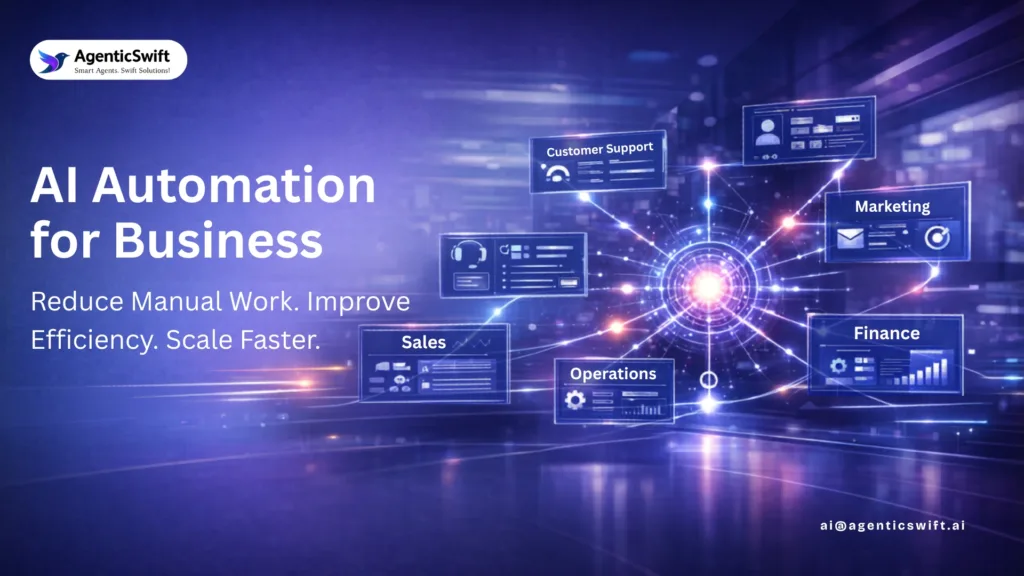
How AI Improves Efficiency in Business
Efficiency is often mentioned as a benefit, but it helps to understand how AI actually creates it.
It Removes Repetitive Work
Teams lose hours every week to low-value tasks. AI helps reduce that burden by handling repetitive actions quickly and consistently.
It Reduces Delays
Workflows often slow down because of approvals, information gaps, tool switching, or manual handoffs. AI helps keep work moving.
It Improves Prioritization
Not every lead, ticket, or task deserves equal attention. AI helps businesses identify what matters most so teams focus on the right work first.
It Connects Disconnected Workflows
Many employees waste time copying information across systems. AI can reduce this friction by connecting tools and automating workflow movement.
It Supports Higher Output Without More Burnout
Efficiency is not only about doing more. It is about doing more without exhausting your team. AI helps businesses increase output while reducing repetitive pressure.
How to Get Started With AI in Business
One of the biggest mistakes businesses make is adopting AI before they understand where it will create real value.
A smarter approach is practical and focused.
1. Identify Repetitive, High-Impact Workflows
Start with workflows that are:
- repetitive
- time-consuming
- prone to errors
- expensive to manage manually
- important to customer experience or revenue
Examples include lead routing, support classification, invoice processing, internal approvals, and recurring reporting.
2. Measure the Current Problem
Before implementation begins, understand the current pain points.
Ask questions like:
- How much time does the process take?
- Where do delays happen?
- How often do errors occur?
- How many people are involved?
- What is the cost of inefficiency?
This gives you a baseline for measuring ROI.
3. Define the Business Outcome
Do not start with “we want AI.”
Start with goals such as:
- reduce response times
- lower manual workload
- improve lead conversion
- reduce errors
- cut operating costs
The technology should support the business goal.
4. Choose the Right First Use Case
The best first AI projects are clear, measurable, and valuable. Start with one focused workflow where the benefit is easy to see.
5. Keep Humans in the Loop
AI should improve productivity, not replace judgment where it still matters. In important workflows, human oversight remains critical.
6. Integrate AI Into Existing Workflows
AI adoption works best when it fits into the way teams already operate. If it creates confusion or adds more steps, adoption will suffer.
7. Track, Refine, and Scale
AI implementation is not a one-time setup. Businesses should track performance, improve the workflow, and scale successful systems into related areas.
What Businesses Should Avoid
AI can create strong results, but poor implementation often leads to disappointment.
Avoid these mistakes:
Automating a Broken Process
If the workflow is already messy, AI will only speed up the mess.
Chasing Hype Instead of ROI
The goal is not to say your business uses AI. The goal is to create measurable value.
Ignoring Team Adoption
If employees do not trust or understand the workflow, they will avoid using it.
Choosing Too Many Tools at Once
Disconnected tools create complexity, poor adoption, and weak outcomes.
Removing Oversight Too Early
Some workflows still need human review, especially where compliance, tone, customer impact, or complex judgment is involved.
Building an AI Strategy That Actually Works
A strong AI strategy is not just a list of tools. It is a business plan for where intelligence should improve speed, accuracy, efficiency, and scale.
A useful strategy should answer:
- Which workflows should be automated first?
- Where is inefficiency costing the business the most?
- Which teams are overloaded with repetitive work?
- Where do delays affect customers or revenue?
- What data is available to support better decisions?
- How will success be measured?
This is where the right implementation partner matters. Businesses do not just need AI tools. They need systems designed around real workflows and measurable business outcomes.
Why Businesses Choose AgenticSwift AI
AgenticSwift AI helps businesses move beyond disconnected tools and manual operations.
Instead of adding more complexity, the goal is to design intelligent workflows that:
- reduce repetitive effort
- improve response speed
- lower operational waste
- support better decisions
- help teams scale with confidence
The real value of AI is not in the buzzword. It is in building systems that make the business work better.
Ready to Turn Manual Workflows Into Intelligent Systems?
If your business is dealing with repetitive processes, rising operational costs, slow internal workflows, or missed efficiency opportunities, AI automation can help.
AgenticSwift AI works with businesses to identify high-impact automation opportunities, design smarter workflows, and implement AI systems that support real growth.
Talk to AgenticSwift AI experts to explore where AI automation can create the biggest impact in your business.
Conclusion
AI automation for business is no longer a future idea reserved for large enterprises. It is becoming one of the most practical ways for businesses to improve efficiency, reduce costs, and scale operations more intelligently.
The businesses that get the best results are not the ones chasing hype. They are the ones that start with real workflow problems, define clear goals, choose the right use cases, and implement AI in a way that creates measurable value.
That is how AI stops being a buzzword and starts becoming a true business advantage.
FAQs
What is AI automation in business?
AI automation in business is the use of artificial intelligence to automate tasks, workflows, and decisions in a smarter and more adaptive way than traditional rule-based systems.
How does AI improve efficiency in business?
AI improves efficiency by reducing repetitive work, speeding up workflows, improving prioritization, lowering manual effort, and helping teams make faster decisions.
What is the difference between AI and automation?
Traditional automation follows fixed rules, while AI can interpret data, understand context, and support more complex decision-making within workflows.
What is the difference between AI and RPA?
RPA handles repetitive digital actions based on fixed instructions, while AI can interpret information, detect patterns, and make limited decisions based on data.
What are the benefits of AI automation for business?
The main benefits include better efficiency, lower operating costs, improved accuracy, faster decisions, stronger customer experience, and easier scalability.
How do businesses get started with AI automation?
Businesses should begin by identifying repetitive, high-impact workflows, measuring current inefficiencies, defining a clear outcome, launching a pilot, and scaling what works.
Is AI automation only for large enterprises?
No. AI automation is increasingly useful for businesses of different sizes, especially those trying to scale operations, reduce costs, and improve productivity without adding unnecessary overhead.
Which business processes are best for AI automation?
Processes that are repetitive, time-consuming, error-prone, and high in business impact are often the best starting points. Examples include support routing, lead qualification, invoice processing, approvals, and reporting.