
Key Takeaways
- Custom AI solutions are purpose-built AI and machine learning systems designed around your specific data, workflows, and business objectives — not adapted from a generic tool.
- AI software development delivers measurable outcomes: up to 40% cost reduction, 25–60% productivity improvement per automated workflow, and real-time decision intelligence where businesses previously waited days for insight.
- The difference between AI and machine learning matters operationally — ML is a subset of AI that learns from data. Custom ML solutions improve continuously as they are exposed to more of your business data.
- Enterprise AI solutions built for your stack outperform off-the-shelf tools on accuracy, integration depth, data ownership, and long-term cost — particularly for complex, domain-specific use cases.
- Insurance, healthcare, legal, HR, and manufacturing are the industries where custom AI and ML solutions are delivering the highest and most measurable ROI in current production deployments.
- Choosing the right AI software development company is the single most consequential decision in an AI project. Domain knowledge matters as much as technical capability.
The Problem with Generic AI Tools — And Why Custom Builds Win
The market for AI software development has never been larger — or more confusing. Businesses face a choice between hundreds of off-the-shelf AI tools that promise to automate everything and custom AI solutions built specifically for their workflows, data, and industry requirements. Most companies start with off-the-shelf. Most eventually realise it was the wrong starting point.
Generic AI tools are built for the median use case. Your insurance claims workflow is not the median. Your healthcare records processing pipeline is not the median. Your legal contract review requirements are not the median. When you deploy a generic tool against a specific operational problem, you get generic results — and you spend significant engineering time trying to fit a tool that was never designed for what you are asking it to do. AI-powered automation only delivers its full value when the model is trained on your data, integrated with your systems, and optimised for your specific decision outputs.
AgenticSwift builds custom AI and ML solutions from the ground up — designed around your data, your stack, and your measurable business outcomes. This guide explains exactly what that means, what it delivers, and how to evaluate whether it is the right approach for your organisation.
| Cost Reduction | Productivity Gain | Time to Insight | ROI Timeline |
| Up to 40% | 25–60% per workflow | Real-time vs days | 6–18 months |
What Are Custom AI & ML Solutions?
Custom AI solutions are artificial intelligence systems designed, trained, and deployed specifically for a single organization’s use case — as opposed to general-purpose AI tools built for broad market use. Custom machine learning solutions take this further: they are ML models trained on your proprietary data, learning the patterns, anomalies, and decision logic specific to your business rather than a generalized dataset.
What makes an AI solution ‘custom’:
- Trained on your data — not a generic public dataset. The model learns from the patterns in your specific operational history, customer behaviour, or document corpus.
- Built for your decision outputs — not adapted from a one-size-fits-all model. The system is optimised for the specific predictions, classifications, or automations your workflow requires.
- Integrated into your existing systems — ERP, CRM, HRIS, claims platform, or document management system — via deep API integration, not surface-level connectors.
- Owned by you — your data, your model weights, your IP. No vendor lock-in, no recurring licence tied to usage volume.
- Maintained and improved on your schedule — retrained as your data grows, updated as your business changes, monitored for drift and accuracy in production.
This is fundamentally different from configuring an off-the-shelf AI tool. Custom machine learning solutions are built, not assembled. The investment is higher at the outset and the ROI is significantly higher over a 2–3 year horizon — both because the model performs better on your specific use case and because you own the capability rather than renting access to someone else’s.
How Can AI and Machine Learning Help Businesses?
Machine learning solutions create business value through three fundamental mechanisms: automating repetitive cognitive tasks that currently consume skilled-worker time, extracting predictive intelligence from historical data that humans cannot process at scale, and enabling real-time decision-making that manual processes cannot match for speed or consistency.
Specific ways AI and machine learning help businesses — with examples:
- Process automation: ML models automate document processing, data entry, classification, routing, and compliance checking. An insurance carrier automating claims intake with AI removes 4–6 hours of manual processing per claim. An HR team automating CV screening processes 10x more applications in the same time.
- Predictive analytics solutions: ML models trained on historical data predict future outcomes — customer churn, equipment failure, credit risk, claim development cost, or demand surges. Businesses using predictive analytics solutions move from reactive decision-making to proactive intervention. A manufacturer predicting equipment failure 72 hours in advance avoids unplanned downtime. An insurer predicting claim severity at intake sets more accurate reserves.
- AI-powered automation of complex decisions: Beyond rule-based automation, ML enables autonomous decision-making on complex, multi-variable problems — fraud detection, real-time pricing, personalised recommendations, anomaly detection in financial data. These are decisions too complex for rules-based systems and too high-volume for human review.
- Natural language processing (NLP): NLP models extract structured data from unstructured text — contracts, clinical notes, customer service transcripts, regulatory filings, emails. Businesses that previously needed staff to read and summarise documents can now process the same content automatically at machine speed.
- Computer vision: Visual AI models inspect, classify, and measure from images and video — damage assessment in insurance claims, quality control in manufacturing, document scanning in legal, and patient identification in healthcare.
- AI integration services for workflow automation: AI and ML solutions for workflow automation connect AI outputs directly to operational systems — triggering actions, updating records, routing tasks, and sending notifications without human intervention at each handoff.
What Is the Difference Between AI and Machine Learning?
This question matters practically because it determines what type of solution you actually need — and what capability you are evaluating when choosing an AI software development partner.
Artificial Intelligence (AI)
AI is the broad discipline of building computer systems that perform tasks that typically require human intelligence — reasoning, understanding language, recognising patterns, making decisions, solving problems. It is the umbrella category.
Machine Learning (ML)
Machine learning solutions are a subset of AI. ML is the specific approach of building systems that learn from data rather than following explicitly programmed rules. An ML model is exposed to historical data, identifies statistical patterns, and uses those patterns to make predictions or decisions on new data it has never seen before. It improves automatically as it processes more data.
The practical distinction for your AI project:
- Rules-based AI: Follows predefined logic. ‘If X and Y, then Z.’ Fast to build, brittle when inputs vary. Cannot handle edge cases outside the rules.
- Machine learning: Learns patterns from data. Handles variability, improves over time, and generalises to new situations. Essential for any use case with complex, variable, or high-volume inputs.
- Deep learning: A subset of ML using neural networks with many layers. Powers computer vision, NLP, and generative AI. Required for unstructured data — images, text, audio, video.
- Generative AI and LLMs: A specific class of deep learning models that generate new content — text, images, code, structured data. The foundation for AI document parsing, AI chatbots, and intelligent report generation.
When AgenticSwift builds custom AI and ML solutions, we select the right approach for each component of your use case — rules-based logic where it is sufficient, ML where variability demands it, deep learning where unstructured data is involved, and generative AI where content generation or NLP is required.
AI Development Services: What AgenticSwift Builds
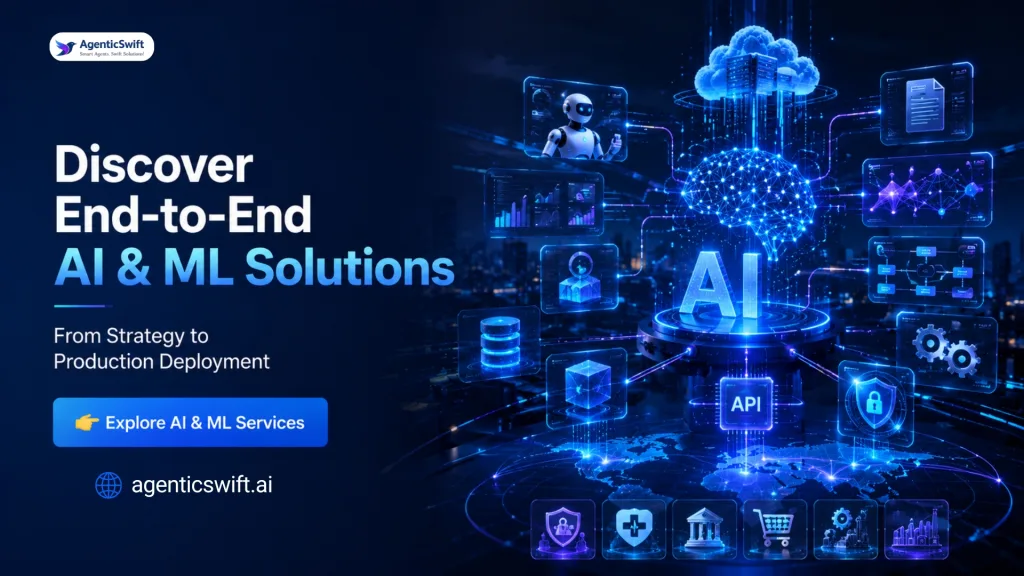
Our AI development services span the full technical stack — from data engineering and model development through MLOps infrastructure, system integration, and production deployment. Here is what custom AI and ML solutions for businesses look like in practice across each capability area.
Custom Machine Learning Model Development
- Supervised learning models: Classification and regression models trained on your labelled historical data. Use cases: fraud scoring, credit risk, claim severity prediction, churn prediction, demand forecasting.
- Unsupervised learning models: Clustering and anomaly detection without labelled training data. Use cases: customer segmentation, outlier detection in financial data, pattern discovery in operational logs.
- Reinforcement learning: Models that optimise decision-making through trial and feedback. Use cases: dynamic pricing, supply chain optimisation, resource allocation.
NLP and Document Intelligence
- Document parsing and extraction: Custom NLP models trained on your document types — insurance claim packages, legal contracts, medical records, HR onboarding forms — extracting structured data at scale.
- Sentiment analysis and text classification: Customer feedback analysis, support ticket routing, compliance document screening.
- Named entity recognition (NER): Identifying and extracting specific entities — dates, amounts, person names, company names, product codes — from unstructured text at document or corpus scale.
Agentic AI and Intelligent Automation
- Agentic AI pipelines: Multi-step AI systems that plan, execute, and adapt to complete complex workflows autonomously — from document intake through decision output through system update, without human involvement at each step.
- AI-powered automation for workflow integration: AI and ML solutions for workflow automation that connect model outputs to ERP, CRM, HRIS, and claims systems via API — triggering actions automatically based on AI decisions.
- AI chatbots and conversational interfaces: Custom-built conversational AI for customer service, claims intake, HR support, and internal knowledge retrieval — trained on your data and integrated with your systems.
Enterprise AI Solutions and MLOps
- Enterprise AI solutions deployment: Production infrastructure for AI models at enterprise scale — containerized model serving, auto-scaling, A/B testing frameworks, and monitoring dashboards.
- MLOps and model lifecycle management: Automated retraining pipelines, drift detection, version control, and performance monitoring in production. Your models stay accurate as your data evolves.
- Predictive analytics solutions and BI integration: ML-powered analytics dashboards and forecasting tools integrated into your existing business intelligence environment.
- AI integration services: End-to-end API integration between AI models and your existing operational systems — no rip-and-replace required. Your AI capability plugs into what you already have.
Which Industries Can Benefit from AI & ML Solutions?
The honest answer is: any industry that processes high volumes of data, makes repeated decisions at scale, or has complex, variable workflows that resist simple rule-based automation. In practice, the industries where custom AI and ML solutions for businesses are delivering the highest measurable ROI right now are:
- Insurance: Claims automation, FNOL processing, fraud detection AI, underwriting automation, policy document extraction, reserve prediction. AgenticSwift’s primary vertical. Proven production deployments.
- Healthcare: Prior authorisation automation, clinical NLP, revenue cycle management, patient record digitisation, predictive readmission modelling, drug interaction screening.
- Legal: Contract data extraction, M&A due diligence automation, discovery document processing, compliance monitoring, clause classification, obligation tracking.
- HR and People Operations: CV and resume parsing, onboarding document automation, compliance expiry monitoring, sentiment analysis on employee feedback, workforce demand forecasting.
- Manufacturing: Predictive maintenance, quality control computer vision, supply chain demand forecasting, defect classification, energy consumption optimisation.
- Financial services: Credit risk modelling, fraud detection, KYC document processing, transaction anomaly detection, regulatory reporting automation.
The common thread across all of these is not the industry — it is the problem type. High-volume, variable-format data. Complex decisions that do not fit clean rules. Processes where accuracy, speed, and scale cannot all be achieved manually. If your operation has these characteristics, custom AI and ML solutions will deliver measurable value.
Why Choose Custom AI Solutions Instead of Ready-Made Software?
This is the most important evaluation question for any business beginning an AI project. Custom AI solutions require higher initial investment than off-the-shelf tools. The question is not which costs more to build — it is which delivers more value over a 3–5 year operational horizon.
| Factor | Off-the-Shelf AI | Custom AI Solutions |
| Fit to your workflow | Generic — built for average use case | Exact — built for your process |
| Data ownership | Shared or vendor-held | Yours entirely |
| Scalability | Vendor roadmap dependent | Scales with your growth plan |
| Integration | Limited API connectors | Deep integration with your stack |
| Competitive advantage | Same tool your competitors use | Proprietary capability only you have |
| Long-term cost | Recurring licence, increasing with volume | Build once, own permanently |
| Domain accuracy | Trained on generic data | Trained on your industry data |
When off-the-shelf AI is appropriate:
- Your use case is genuinely generic — email spam filtering, basic sentiment analysis, standard OCR on uniform documents.
- Your data volumes are low and accuracy requirements are not critical.
- You need to move fast with minimal engineering investment and can accept lower accuracy.
When custom AI solutions are the correct choice:
- Your documents, workflows, or decision logic are domain-specific and variable. Generic models will underperform.
- Data privacy requires that your data never leaves your environment or a vendor’s shared model.
- You are building a capability that differentiates you from competitors — you cannot build a competitive moat on software your competitors also use.
- Your volumes are high enough that recurring per-document, per-user, or per-API-call pricing will exceed the cost of a custom build within 12–24 months.
- Accuracy thresholds are high — healthcare, insurance, and legal use cases where errors have material consequences require domain-specific training that generic models cannot match.
Why Choose AgenticSwift as Your AI Software Development Partner?
Choosing the right AI software development company is the decision that determines whether your AI project succeeds or becomes a case study in expensive failure. Technical capability is table stakes. What separates AI projects that deliver production ROI from those that deliver demos is domain expertise — a development team that understands your industry, your data, and your operational constraints as deeply as they understand the engineering.
What AgenticSwift brings to every AI development engagement:
- Insurance, healthcare, legal, and HR domain depth: Our AI consulting services are grounded in the workflows, compliance requirements, and data characteristics of the industries we serve. We have built and deployed AI in these verticals — we do not learn your industry during your project.
- End-to-end AI development services: Strategy and use-case definition, data engineering, model development, MLOps infrastructure, system integration, and production deployment — under one engagement. No vendor handoffs between the team that designed the model and the team that deploys it.
- Production-grade engineering standards: Every custom AI solution we build is engineered for production from day one — not a proof-of-concept that requires a rebuild before it can scale. Containerised, monitored, version-controlled, and documented.
- Proprietary AI products: Alongside bespoke custom builds, AgenticSwift’s own AI Document Parser and AI RPA products give clients production-ready components that can be deployed faster and customised to their specific requirements.
- AI integration services that fit your stack: We build to integrate — not to require you to replace. Our AI models connect to your existing ERP, HRIS, CRM, and claims systems via well-documented APIs without forcing infrastructure change.
Frequently Asked Questions
How can AI and machine learning help businesses?
AI and machine learning help businesses in three primary ways: automating repetitive cognitive tasks that consume skilled-worker time (document processing, data entry, classification), extracting predictive intelligence from historical data at a scale humans cannot match (churn prediction, fraud scoring, demand forecasting), and enabling real-time decision-making on complex, multi-variable problems (dynamic pricing, anomaly detection, personalised recommendations). Machine learning solutions improve continuously as they process more of your data, meaning the value compounds over time rather than remaining static. AI-powered automation of end-to-end workflows eliminates manual handoffs and reduces cycle times by 25–60% in production deployments.
What are custom AI & ML solutions?
Custom AI solutions are AI and machine learning systems designed, trained, and deployed specifically for one organisation’s use case — not adapted from a general-purpose tool. Custom machine learning solutions are trained on your proprietary data, learning the patterns and decision logic specific to your business. They are integrated into your existing systems, owned entirely by you, and improved on your timeline. The defining characteristic is specificity: the model is optimised for your documents, your workflows, your accuracy requirements, and your data — not a generic dataset that approximates your industry.
Which industries can benefit from AI & ML solutions?
Any industry processing high-volume, variable-format data or making complex repeated decisions at scale can benefit from AI and ML solutions. In current production deployments, the highest ROI is seen in insurance (claims automation, fraud detection, underwriting), healthcare (prior auth, clinical NLP, revenue cycle), legal (contract extraction, due diligence, discovery), HR (onboarding automation, CV parsing, compliance monitoring), manufacturing (predictive maintenance, quality control, supply chain), and financial services (fraud detection, credit risk, KYC automation). The determining factor is not the industry — it is the problem type.
What is the difference between AI and machine learning?
AI is the broad category of systems performing tasks that typically require human intelligence — reasoning, language understanding, decision-making. Machine learning is a specific subset of AI: systems that learn patterns from data rather than following pre-programmed rules, improving automatically as they process more data. Deep learning is a further subset of ML using neural networks, powering computer vision and NLP. Generative AI is a class of deep learning models that produce new content — text, structured data, images. When building custom AI solutions, the right approach for each component depends on the specific input type, decision complexity, and data availability.
Why should businesses choose custom AI solutions instead of ready-made software?
Custom AI solutions outperform off-the-shelf tools on domain accuracy, integration depth, data ownership, and long-term cost for any use case that is not genuinely generic. Generic AI tools are trained on broad datasets — they perform at average accuracy on average inputs. If your documents, workflows, or decisions are domain-specific (insurance claims, legal contracts, medical records), a custom model trained on your data will outperform a generic tool on accuracy from the first month of production. Additionally, you own the model — no recurring licence that scales with volume, no vendor dependency, no competitor using the same tool. The ROI crossover point versus recurring off-the-shelf licensing typically occurs within 12–24 months at enterprise volumes.
Build AI That Works Exactly the Way Your Business Needs It To
Off-the-shelf AI tools are built for the average use case. Your business is not average. The workflows that create your competitive advantage, the data that defines your customer relationships, the decisions that drive your margins — these require AI built specifically for you.
AgenticSwift is a custom AI solutions provider and AI software development company that builds production-grade machine learning models, intelligent automation systems, agentic AI pipelines, and AI integration services for insurance, healthcare, legal, HR, and enterprise operations. Our AI development services span strategy through deployment — from your first AI roadmap to a fully operational model in production.
We do not sell generic tools. We build what you need.