
Every AI capability a business uses — the chatbot answering customer queries, the model flagging fraudulent claims, the system parsing thousands of invoices a day — started life as a Jupyter notebook on someone’s laptop. The journey from that notebook to a production system serving millions of predictions reliably is where most AI initiatives quietly succeed or fail. AI Model development and deployment is the discipline of making that journey repeatable, scalable, and trustworthy.
For modern businesses, this is no longer optional engineering plumbing — it’s the difference between AI projects that deliver measurable ROI and AI projects that stall in proof-of-concept purgatory. This guide walks through what model development involves, how deployment works, where MLOps fit, and how to think about building (or buying) scalable AI solutions for the enterprise.
Key Takeaways
- ML model development spans far more than algorithm selection — it’s an end-to-end lifecycle covering problem framing, data engineering, training, validation, and packaging for production.
- AI model deployment is what converts a trained model into business value, exposing it through APIs, batch pipelines, or edge runtimes so real users and systems can consume predictions.
- Industry studies consistently show that the majority of ML models never reach production — typically due to deployment complexity, data drift, and missing MLOps practices, not bad modeling.
- MLOps services bring DevOps rigor to machine learning — automating training, versioning, monitoring, and retraining, which is what makes ML pipeline automation possible at enterprise scale.
- Scalable AI solutions require architectural choices upfront: real-time vs batch serving, cloud vs edge deployment, GPU vs CPU inference, and centralized vs federated training.
- Common deployment patterns include REST/gRPC APIs, streaming inference, batch scoring, and on-device models — each with different latency, cost, and complexity profiles.
- Choosing AI model development services vs building in-house comes down to talent availability, time-to-value, domain specificity, and long-term operating costs.
What Is Model Development in AI?
Model development is the structured process of turning a business problem into a working machine learning system. It’s the front half of the AI lifecycle — everything that happens before a model is ready to be deployed.
A serious model development workflow typically covers:
1. Problem framing. What decision is the model supporting? What does “good” look like? What’s the cost of a false positive vs a false negative? This step is the most underrated — most failed ML projects fail here, not in training.
2. Data collection and preparation. Gathering training data, cleaning it, handling missing values, balancing classes, generating labels, and engineering features. For most production projects, data work consumes 60–80% of total effort.
3. Algorithm or architecture selection. Choosing the right family of models — classical ML (gradient boosting, random forests), deep learning (CNNs, transformers), or specialized architectures (graph neural networks, diffusion models, foundation models fine-tuned for the task).
4. Training and validation. Running training loops, tuning hyperparameters, cross-validating, and evaluating against held-out test sets. Modern training services may use distributed compute, mixed precision, and automated hyperparameter search.
5. Model evaluation. Beyond accuracy — fairness, robustness, calibration, latency, memory footprint, and behavior on edge cases. A model that’s 99% accurate but 500ms slow may be unusable in production.
6. Packaging. Exporting the model in a deployable format (ONNX, TorchScript, TensorFlow SavedModel, Triton, etc.), bundling dependencies, and preparing it for handoff to deployment infrastructure.
Done well, end-to-end ML model development solutions produce a model that’s not just accurate but also reproducible, auditable, and ready for the realities of production traffic.
What Is AI Model Deployment?
AI model deployment is the process of taking a trained model and making it available for real-world use — serving predictions to applications, users, or other systems at the latency, throughput, and reliability the business requires.
Concretely, deployment involves:
- Packaging the model and its dependencies into a portable artifact (typically a container).
- Serving infrastructure — REST/gRPC APIs, streaming consumers, batch jobs, or on-device runtimes.
- Scaling — autoscaling to handle traffic spikes, load balancing across replicas, GPU/CPU resource management.
- Monitoring — tracking prediction latency, throughput, error rates, input distributions, and prediction distributions.
- Versioning and rollback — managing multiple model versions, canary releases, A/B testing, and safe rollbacks when a new model misbehaves.
- Governance — logging predictions for audit, ensuring compliance with privacy regulations, supporting explainability requests.
The fact that deployment is the harder half of the lifecycle is widely acknowledged across the industry. A model that achieves state-of-the-art accuracy in a research environment may collapse the moment it meets real production traffic — inconsistent inputs, latency constraints, infrastructure failures, and the dreaded data drift that quietly erodes model accuracy over weeks and months.
The End-to-End ML Lifecycle
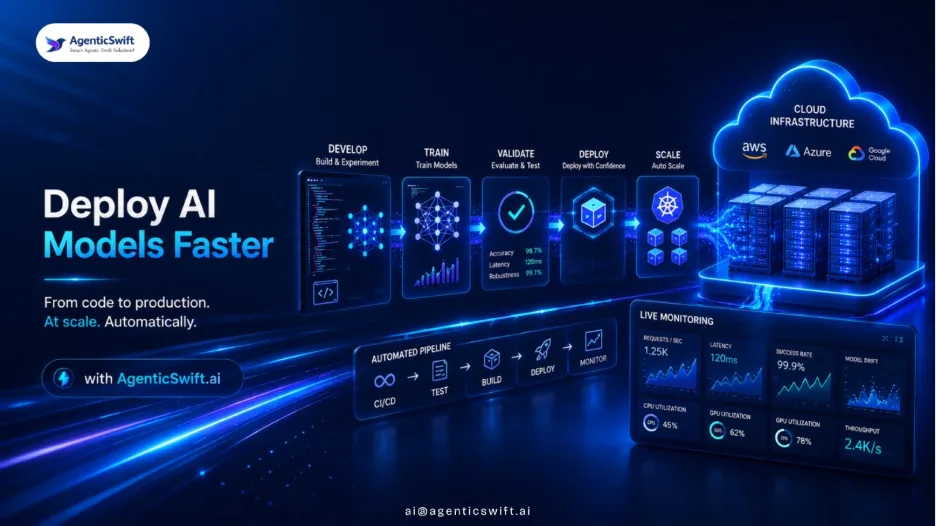
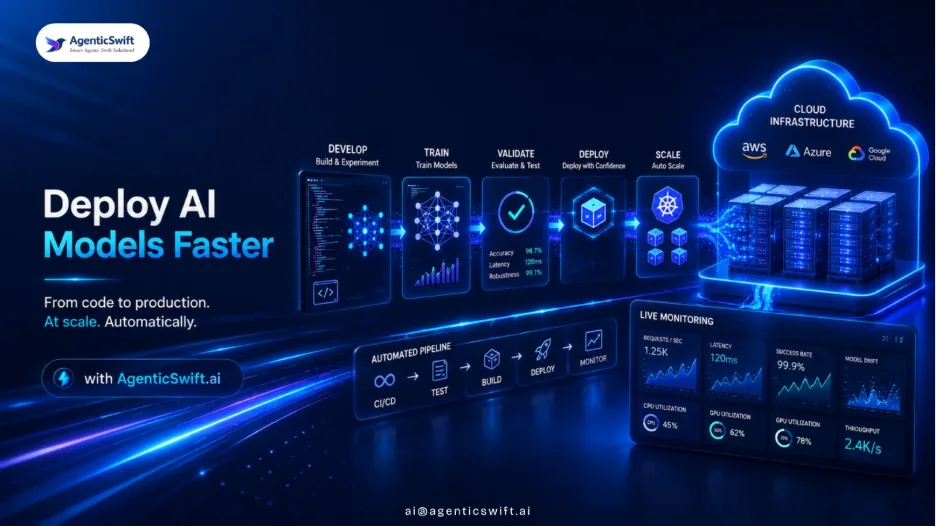
A mature AI model development and deployment workflow looks roughly like this:
Business problem
↓
Data collection & labeling
↓
Feature engineering
↓
Model training & validation
↓
Model packaging
↓
Deployment (API / batch / edge)
↓
Monitoring & observability
↓
Retraining & updates
↓
(loop back to data collection)
The critical insight: this is a loop, not a pipeline. Production models drift as the world changes. Customer behavior shifts. New vendors send invoices in new formats. Fraud patterns evolve. A model deployed and forgotten loses value steadily. Scalable AI model deployment services treat the lifecycle as continuous, with automated retraining triggered by monitoring signals rather than calendar reminders.
Deployment Architectures: Choosing the Right Pattern
Not every model needs to be a real-time API. Choosing the right serving pattern shapes cost, latency, and complexity for years afterward.
Real-Time Serving (Online Inference)
The model is exposed as a REST or gRPC endpoint. Requests arrive, predictions return in milliseconds. This is the right choice when predictions block a user-facing flow — fraud scoring at checkout, recommendations on page load, chatbot responses, document parsing API calls.
Tradeoffs: higher infrastructure cost, harder scaling, latency-sensitive engineering.
Batch Inference
The model scores large datasets on a schedule — nightly, hourly, weekly. Predictions land in a database or warehouse, where downstream systems consume them. Use this for churn scoring, demand forecasting, lead scoring, or claims triage queues.
Tradeoffs: much cheaper, much simpler, but predictions are stale between runs.
Streaming Inference
The model scores events as they flow through a message queue (Kafka, Kinesis, Pub/Sub). Useful for IoT, telemetry, real-time monitoring, and fraud detection on transaction streams.
Tradeoffs: sits between batch and real-time in complexity; requires streaming infrastructure expertise.
Edge Deployment
The model runs on-device — phones, vehicles, cameras, industrial sensors, AR/VR headsets, robotics platforms. Critical when latency must be sub-millisecond, bandwidth is constrained, or privacy requires data to stay local.
Tradeoffs: model size constraints, hardware fragmentation, harder updates and monitoring.
Hybrid Patterns
Many real systems combine these — edge models doing fast local inference with periodic cloud retraining, or real-time APIs falling back to cached batch predictions for resilience.
MLOps and ML Pipeline Automation
If model development is about building the model, MLOps is about everything that keeps the model alive in production.
MLOps services bring software-engineering discipline to ML systems. The core practices include:
- Version control for everything — code, data, models, configurations, training environments.
- Automated training pipelines — triggered on new data, code changes, or schedule, running on managed compute (Kubeflow, Airflow, Vertex Pipelines, SageMaker Pipelines, Metaflow, etc.).
- Model registries — central catalogs tracking every model version, its training data, metrics, lineage, and deployment status.
- CI/CD for models — automated testing of new model versions before promotion: accuracy gates, latency tests, fairness checks, security scans.
- Production monitoring — tracking prediction distributions, input drift, accuracy on labeled feedback, infrastructure health.
- Automated retraining and rollback — closing the loop when monitoring detects drift or degraded performance.
The payoff of mature ML pipeline automation is dramatic. Teams that previously took months to deploy a new model can ship in days. Models that previously degraded silently get caught and refreshed automatically. Compliance and audit become first-class outputs of the system rather than painful retroactive efforts.
What Scalable AI Solutions Actually Require
“Scalable” gets thrown around loosely. In practice, scalable AI solutions need to deliver on several dimensions simultaneously:
- Throughput scaling — handling thousands or millions of predictions per second without degrading latency. Achieved through horizontal autoscaling, GPU batching, model quantization, and efficient serving runtimes (Triton, TorchServe, BentoML, KServe).
- Cost scaling — not just running fast, but running affordably. This means right-sizing instances, using spot/preemptible compute for training, caching predictions where possible, and choosing the smallest model that solves the problem.
- Operational scaling — the team running the system shouldn’t grow linearly with the number of models in production. This is what MLOps enables.
- Organizational scaling — multiple teams shipping models on shared infrastructure without stepping on each other. Requires platform thinking — shared feature stores, model registries, and serving infrastructure.
- Geographic scaling — multi-region deployment, data residency compliance, and edge presence for latency-sensitive applications.
A model that works perfectly for one customer but can’t be replicated for the next ten is not scalable, no matter how impressive its accuracy.
Industries Using AI Model Deployment Services
Nearly every data-mature industry runs deployed ML models today:
- Finance — credit scoring, fraud detection, algorithmic trading, AML monitoring, document automation for loan underwriting.
- Insurance — claims triage, underwriting automation, fraud detection, customer churn prediction (covered in detail in our AI in insurance guide).
- Healthcare — diagnostic imaging, patient risk stratification, clinical NLP, drug discovery, document parsing for medical records.
- Retail and e-commerce — recommendation engines, dynamic pricing, demand forecasting, inventory optimization, visual search.
- Manufacturing — predictive maintenance, quality inspection via computer vision, supply chain optimization, robotics control.
- Logistics — route optimization, ETA prediction, warehouse robotics, customs document automation.
- Media and entertainment — content recommendation, automated tagging, content moderation, generative production tools.
- Document-heavy operations — intelligent document processing systems (see our AI document parsing guide) that themselves rely on multiple deployed models for layout, OCR, and field extraction.
The common thread: anywhere decisions are made repeatedly at scale, a deployed ML model can either automate the decision entirely or augment the humans making it.
Build In-House or Use AI Model Development Services?
This is the practical question every business leader eventually faces. Both paths are valid; the right choice depends on your situation.
Building In-House Makes Sense When:
- ML is a core differentiator for the business (the model is the product).
- You have or can recruit experienced ML engineers and MLOps talent.
- The problem space is highly specific to your domain and data.
- You expect to run many models long-term and want platform leverage.
- Data sensitivity requires keeping everything internal.
AI Model Development Services Make Sense When:
- ML supports the business but isn’t the differentiator.
- Talent is scarce or expensive in your market.
- Time-to-value matters more than long-term platform ownership.
- The problem maps to an established pattern (document parsing, demand forecasting, churn modeling).
- You want to start with a vendor’s pre-built infrastructure and graduate to in-house later.
A common and pragmatic path: start with custom machine learning model training and deployment services for the first few use cases, build internal capability alongside, and gradually insource as the AI portfolio grows. This avoids the trap of either spending two years building infrastructure before shipping anything, or being locked into vendors forever.
What to Look for in AI Deployment Solutions
If you’re evaluating vendors or platforms for machine learning model deployment for enterprises, here’s a practical checklist:
- End-to-end coverage — training, deployment, monitoring, retraining, governance. Stitched-together tools become their own maintenance burden.
- Cloud-agnostic or multi-cloud support — avoiding vendor lock-in matters more as your AI footprint grows.
- Real production references — case studies in your industry, with measurable outcomes, not just marketing slides.
- MLOps maturity — pipelines, registries, monitoring, drift detection, automated retraining as built-in capabilities.
- Security and compliance — SOC 2, ISO 27001, HIPAA, GDPR, data residency controls.
- Integration depth — how it plugs into your existing data warehouse, observability stack, identity systems, and downstream applications.
- Cost transparency — clear pricing for training compute, inference, storage, and engineering support. Surprises here scale badly.
- Exit strategy — can you take your models, data, and pipelines elsewhere if needed? If not, you’re locked in.
The Bigger Picture
The gap between “we trained a model” and “we run AI in production” is where most enterprise AI initiatives still struggle. Algorithms are increasingly commoditized — anyone can fine-tune a state-of-the-art model from an open repository in a few hours. What separates organizations that get measurable value from AI is the discipline around deployment, monitoring, and continuous improvement.
The companies winning at AI right now aren’t necessarily the ones with the best models. They’re the ones with the best systems for shipping models — the ones that treat model development and deployment as a continuous capability rather than a one-off project. Digital transformation through AI isn’t about any single deployed model; it’s about building the muscle to deploy the next one, and the one after that, faster and more reliably each time.
Whether built in-house or sourced through AI model development services, that capability is what turns AI from a recurring slide in the strategy deck into a measurable line on the income statement.
Frequently Asked Questions
Frequently Asked Questions
Model development in AI is the end-to-end process of building machine learning systems — defining the problem, collecting and preparing data, selecting algorithms, training and validating models, and tuning performance. It transforms raw data into predictive systems that solve business problems. Quality model development determines whether downstream deployment delivers accurate, reliable, and scalable results.
What is AI model deployment?
AI model deployment is the process of moving a trained machine learning model from development into production — where it serves real predictions to applications, users, or systems. It involves packaging the model, building APIs, configuring infrastructure, monitoring performance, and handling versioning. Deployment is what turns a research artifact into a working business capability.
Why is model deployment important?
A model that never reaches production delivers zero business value, no matter how accurate. Deployment bridges the gap between data science experiments and real-world impact, enabling real-time predictions, automation, and decision support at scale. It also exposes models to drift, edge cases, and feedback loops that drive continuous improvement and measurable ROI.
What industries use AI model deployment services?
Nearly every data-driven industry relies on deployed ML models. Finance uses them for fraud detection and credit scoring, healthcare for diagnostics and patient risk, retail for recommendations and demand forecasting, logistics for route optimization, manufacturing for predictive maintenance, and insurance for claims and underwriting. Any business with data, decisions, and scale benefits from AI deployment.
What are the benefits of MLOps in model deployment?
MLOps brings DevOps principles to machine learning — automating training pipelines, versioning models and data, monitoring drift, and enabling continuous retraining. It reduces deployment time from months to days, improves model reliability, ensures reproducibility, and supports governance. Teams ship faster, debug easier, and maintain production models without the chaos of ad-hoc workflows.