
AI DocNexus for Intelligent Document Automation
Document handling is one of the largest invisible costs in modern enterprise operations. Teams in finance, legal, HR, and operations spend a substantial share of each working day opening files, locating values, entering data into systems of record, and verifying entries that another reviewer already keyed. None of this work appears in a revenue line, yet it shapes cycle times, data quality, audit posture, and the capacity of every team that touches a document.
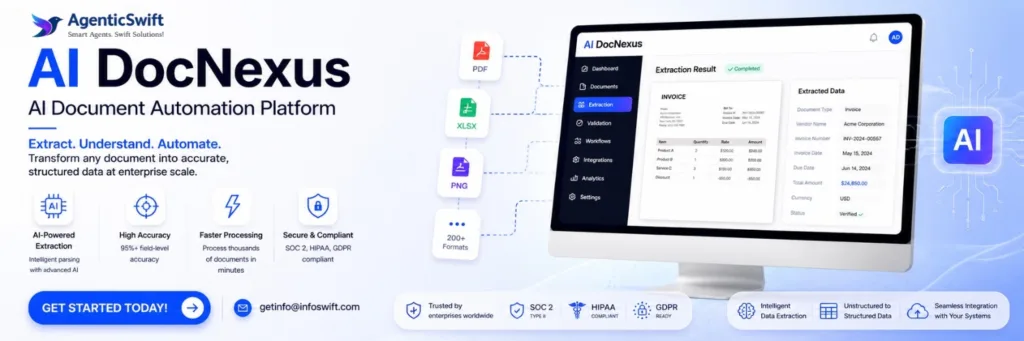
AI DocNexus, the AI document parsing platform developed by AgenticSwiftAI, is built to remove that bottleneck. As an enterprise-grade intelligent document processing (IDP) platform, it reads complex business documents, extracts the data that matters, classifies the document type, and delivers structured output directly into the systems where downstream work happens.
This guide explains what AI DocNexus is, how it differs from traditional OCR and template-based tools, the document categories it supports, and why mid-market and enterprise teams are adopting this approach across finance, legal, HR, and operations.
What AI DocNexus delivers
- Automated extraction of fields, tables, signatures, and contextual values from complex business documents.
- Intelligent classification that routes invoices, contracts, HR forms, and shipping records to the correct downstream workflow without manual sorting.
- Scalable processing that runs thousands of documents in parallel with enterprise-grade accuracy.
- Direct integration with the ERP, CRM, and data management systems your operation already runs on.
What Is an AI Document Parser?
An AI document parser is software that converts business documents — invoices, contracts, forms, statements, scanned files — into structured data that downstream systems can consume without manual intervention.
The category spans a wide range of capability. Optical character recognition (OCR) sits at the simpler end: it converts pixels into text and stops there. Template-based parsers extend OCR by mapping fields to fixed coordinates on the page, but they break when layouts change. Intelligent document processing platforms occupy the most advanced end of the spectrum, combining OCR, computer vision, natural language understanding, and workflow automation in a single pipeline.
AI DocNexus belongs to this third category. The platform identifies the document type, locates meaningful fields by context rather than fixed position, validates the extracted output, and delivers structured data into the business systems that handle the next step in the workflow.
Meet AI DocNexus
AI DocNexus is the AI document parsing platform developed by AgenticSwiftAI. The platform combines computer vision and natural language processing to read complex business documents the way an experienced reviewer would — by understanding them rather than simply transcribing them.
Three design principles distinguish AI DocNexus from earlier generations of document automation tools.
Built for variability, not templates
AI DocNexus classifies and extracts based on document content and context rather than fixed coordinate maps. This is what allows the platform to handle the natural variability of vendor invoices, third-party contracts, and forms with handwritten annotations — documents that template-based parsers struggle to process consistently.
Enterprise integration as a first-class concern
Parsed output flows directly into ERP, CRM, and data management platforms. AI DocNexus is designed to close the loop between document arrival and downstream business action, not to produce structured files that still require manual movement between systems.
Domain-trained models for real workflows
AI DocNexus uses models trained on the document patterns that appear in finance, legal, HR, and operations specifically. Domain adaptation is among the strongest predictors of accuracy on production documents, and the platform is engineered around that principle.
The combined effect is a platform capable of handling the documents your organization actually processes — including the ones that do not conform to a clean template.
Why Traditional Document Processing Falls Short
Most enterprises have already deployed some form of document automation. The patterns of failure tend to be consistent across organizations and industries.
OCR alone produces text, not data
Once OCR has converted a document into recognized characters, a reviewer still needs to identify the invoice number, vendor name, payment terms, and line items. The work has not been automated; it has only been moved upstream of the keying step.
Template parsers cannot keep up with reality
A vendor changes its invoice format. A contract follows an unfamiliar structure. A regulatory form is updated to a new revision. Each event triggers a template update, and at scale the maintenance overhead of a rule-based parser can exceed the time it was meant to save.
Manual review does not scale
Adding reviewers to absorb higher document volumes is a finite strategy. Headcount grows linearly with document volume; accuracy does not. Throughput becomes constrained by reviewer attention rather than by business demand.
The platforms that perform reliably today are those that handle document variability without breaking, including documents that no engineer mapped in advance. AI DocNexus is built for that environment.
How AI DocNexus Works
AI DocNexus brings together two AI disciplines that earlier tools applied in isolation. Computer vision handles visual layout — tables, signatures, checkboxes, stamps, form regions. Natural language processing handles meaning — what the words say, how fields relate to each other, and which values belong to which entity. Combined, these capabilities allow the platform to read documents the way an experienced reviewer would: by understanding them, not by transcribing them.
From a workflow standpoint, four operations occur in sequence.
Classification. The platform identifies the document type — invoice, purchase order, contract, HR form, shipping record — which determines the extraction logic that applies.
Extraction. Key fields are pulled from the document: names, dates, totals, line items, identifiers, references, signatures, and the contextual values that matter for downstream use.
Validation. Extracted values are checked against expected patterns and business rules so errors surface before the data reaches production systems.
Integration. Structured output flows into ERP, CRM, and data management platforms, where the next step in the business process picks it up automatically.
Core Capabilities of AI DocNexus
The platform’s value comes from how its capabilities operate together rather than from any single feature in isolation.
Automated data extraction
AI DocNexus identifies and extracts the fields that matter — names, dates, totals, compliance values, and contextual metadata — across diverse document types without requiring per-document configuration.
Intelligent classification
The platform sorts of incoming files by content, format, and context. Knowing the document type is a prerequisite for applying the correct extraction logic, and AI DocNexus makes that determination automatically.
Scalable processing
AI DocNexus runs thousands of documents in parallel with enterprise-grade accuracy. Throughput scales with infrastructure rather than with reviewer headcount, which is essential for organizations operating at high document volumes.
Seamless integration
The platform connects parsed output directly into ERP, CRM, and data management systems, closing the loop between document arrival and downstream business action. This integration model is the difference between a parser and an end-to-end automation platform.
From Rule-Based Parsing to Agentic Document Extraction
A newer pattern in this space — commonly described as agentic document extraction — moves away from rigid templates toward systems that reason about documents the way a person would. Rather than asking what is at coordinates X, Y on this page, an agentic system asks what kind of document this is, what it represents, and which information is meaningful.
The shift is consequential in production environments. Vendor invoices change layout. Contract templates evolve across counterparties. Onboarding paperwork includes margin notes and handwritten exceptions. Rule-based parsers fail in each case. An agentic approach handles them as routine work because it is not attempting to match a template; it is attempting to understand a document.
AI DocNexus applies this principle across its extraction pipeline. Documents are recognized by content rather than filename. Fields are located by what they mean rather than where they sit. And outputs are validated against the business context the document operates in, which dramatically reduces the maintenance burden compared with template-driven tools.
Supported Document Types
AI DocNexus is positioned around four primary domains. Each represents a category in which document-driven work creates measurable operational drag.
1. Financial documents
Finance and accounting teams handle some of the highest-volume document workflows in the enterprise. AI DocNexus supports:
- Invoices and purchase orders
- Bank statements and financial reports
- Tax documents and compliance forms
- Expense reports and receipts
In accounts payable, automation typically translates to faster invoice cycle times, fewer keying errors, and a smoother month-end close.
2. Legal and contract documents
Legal teams contend with both volume and variability — every contract is structurally similar but textually unique. Supported documents include:
- Legal agreements and contracts
- Compliance documentation
- Regulatory filing documents
- Policy and procedure manuals
The output is structured field data and clause-level identification suitable for contract lifecycle management, compliance reporting, and legal review queues.
3. Human resources documents
HR operations carry a steady stream of forms, files, and records that consume meaningful time without generating revenue. Supported documents include:
- Employee onboarding paperwork
- Performance reviews and assessments
- Benefits and insurance forms
- Training and certification records
Automating intake at this stage produces faster onboarding cycles and a cleaner, more searchable employee record system.
4. Operations and logistics documents
Supply chain workflows are document-heavy and time-sensitive. A delayed shipping document does not simply remain in a queue — it holds up a physical movement of goods. AI DocNexus handles:
- Shipping and delivery documentation
- Inventory management forms
- Quality assurance reports
- Vendor and supplier documents
The result is faster document turnaround in the operational chokepoints where speed translates directly into cost savings.
Why AgenticSwiftAI
Several characteristics distinguish AgenticSwiftAI’s approach from generic document AI offerings.
Domain-adapted models
AI DocNexus is not a single undifferentiated extractor applied to every document type. Its models are trained for the specific document patterns found in finance, legal, HR, and operations — and domain adaptation is among the strongest predictors of real-world extraction accuracy.
High accuracy on production documents
The deep learning architecture underpinning AI DocNexus is built for the variability that production documents actually exhibit: layout drift, image quality issues, mixed structured and unstructured content, and handwritten annotations.
Enterprise security and compliance
The platform adheres to enterprise data protection and compliance standards — a non-negotiable requirement for finance, legal, healthcare, insurance, and any other regulated industry.
End-to-end automation
The workflow runs uninterrupted from document ingestion through classification, extraction, validation, and integration with business systems. There is no handoff to a separate tool to complete the job.
Where AI DocNexus Pays Off
The clearest returns tend to come from three sources.
Manual data entry reduction. Teams currently retyping values from documents into systems of record see the most immediate impact. AI DocNexus absorbs that workload entirely, freeing reviewer capacity for higher-value tasks.
Cycle time on document-driven processes. Invoice approval, claims handling, contract intake, and employee onboarding share a common pattern: the document itself is the bottleneck. Automated parsing compresses turnaround in each of these workflows.
Data quality and downstream error cost. When document errors carry meaningful cost — incorrect payments, missed compliance windows, mis-routed claims — the value of automated extraction and validation routinely exceeds the platform’s cost within a single operational quarter.
If any of these scenarios describes your current operation, AI DocNexus warrants a closer evaluation.
Beyond Document Automation
Document parsing rarely operates in isolation. Once documents are producing structured data automatically, the next question typically concerns the conversational and process layer that consumes that data — answering questions, routing approvals, surfacing exceptions, and handling customer interactions that reference document content.
AgenticSwiftAI’s AI Chatbot product extends this intelligence into real-time interactions, providing customer support, HR, and enterprise service teams with a context-aware layer built on top of the data AI DocNexus produces. For organizations evaluating broader AI automation strategy, the two products complement each other directly.
Frequently Asked Questions
What is AI DocNexus?
AI DocNexus is the AI document parsing platform developed by AgenticSwiftAI. It is an intelligent document processing (IDP) platform that automatically reads, extracts, classifies, and validates information from complex business documents, then delivers structured output to ERP, CRM, and data management systems.
What is an AI document parser?
An AI document parser is software that automatically reads business documents, extracts the relevant data, classifies the document type, and outputs structured data for downstream systems. AI DocNexus is an enterprise-grade example of this category.
What is intelligent document processing (IDP)?
Intelligent document processing combines OCR, computer vision, natural language understanding, and workflow automation into a single pipeline that converts documents into validated, structured data. IDP differs from basic OCR by understanding document context, classifying types, and validating output before integration with business systems.
How is AI DocNexus different from OCR?
OCR converts characters in an image into text. AI DocNexus extends well beyond that — it identifies the document type, locates meaningful fields by context, validates the extracted values, and pushes structured data directly into ERP, CRM, and other operational systems.
What document types does AI DocNexus support?
The platform handles documents across four primary domains: financial (invoices, bank statements, tax forms, expense reports), legal (contracts, compliance documents, regulatory filings), HR (onboarding paperwork, performance reviews, benefits forms), and operations (shipping documents, inventory forms, QA reports, vendor documents).
Can AI DocNexus handle unstructured documents?
Yes. The platform is designed for both structured and unstructured documents. This is the principal reason organizations migrate to AI DocNexus from template-based tools — documents with variable layouts, handwritten annotations, and irregular structures are routine cases rather than edge cases.
How does AI DocNexus integrate with existing systems?
AI DocNexus connects with ERP, CRM, and data management systems to deliver structured output directly into the platforms where downstream work occurs. The integration model is built for end-to-end automation rather than one-off file exports.
Is AI DocNexus secure?
Yes. The platform adheres to enterprise data protection and compliance standards. For organizations in regulated industries — finance, healthcare, insurance — security and compliance posture are foundational rather than optional.
Who is AI DocNexus built for?
AI DocNexus is designed for mid-market and enterprise organizations with high document volume across finance, legal, HR, operations, or compliance functions. Teams that have outgrown OCR or template-based parsing are typically the strongest fit.
How do I evaluate AI DocNexus for my workflow?
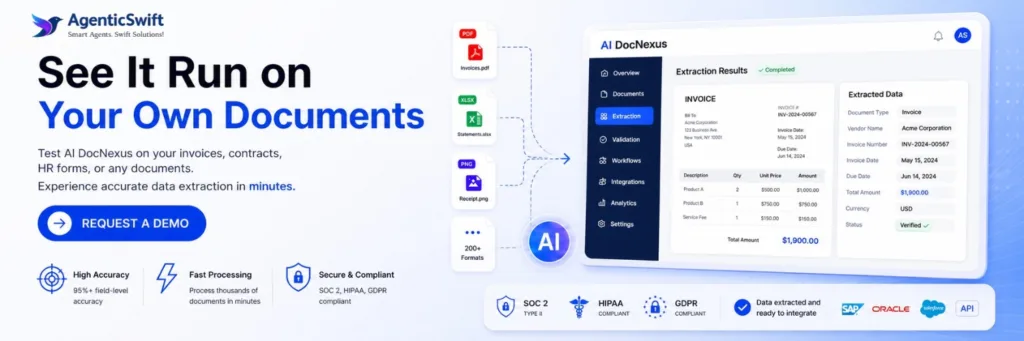
The most informative evaluation runs your actual documents through the platform. AgenticSwiftAI offers a working demo for this purpose, allowing you to assess classification accuracy, extracted field quality, and integration output on the document types your operation handles every day.