
Introduction
The insurance industry runs on documents.
Policy applications, claim forms, invoices, repair estimates, medical reports, endorsements, renewal papers, and compliance files all move through document-heavy workflows every day. When these documents are handled manually, insurers often face slower turnaround times, more operational errors, delayed claims, and overloaded teams.
That is exactly why AI document parsing in the insurance industry has become a high-value automation opportunity. AI is increasingly being used by insurers to automate routine work such as document verification, claims intake, data extraction, fraud detection support, and underwriting-related processing.
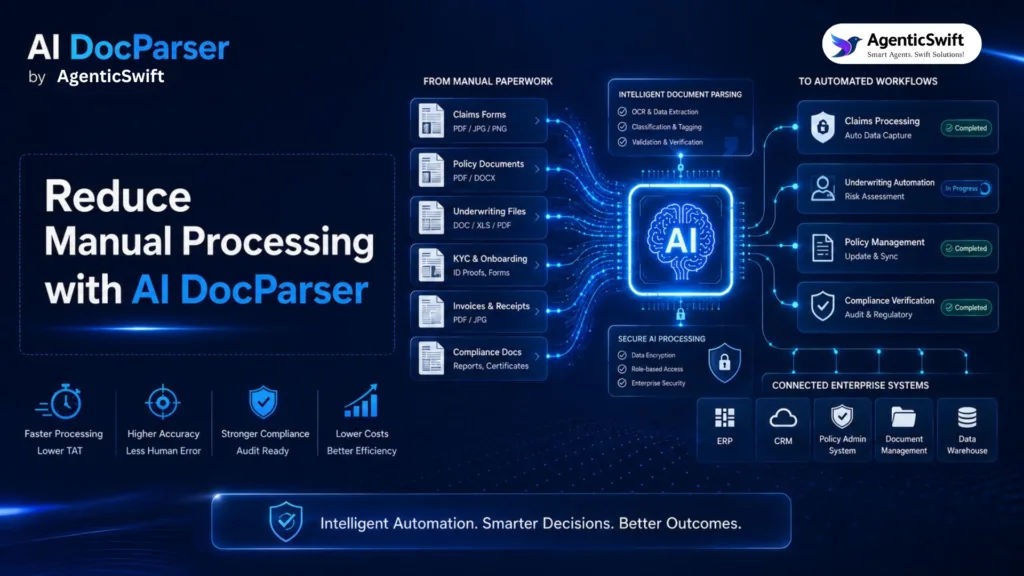
For businesses looking at practical document automation, AI Document parser by AgenticSwift is positioned as an AI Document Parser that can automatically read, extract, and classify information from complex business documents, support both structured and unstructured data, process high volumes, and integrate with enterprise systems for end-to-end automation.
This blog explains the top use cases of AI document parsing in insurance, how these use cases support real insurance operations, and why a solution like AI Doc Parser fits the commercial and operational needs of insurers.
What Is AI Document Parsing in Insurance?
AI document parsing is the use of AI, natural language processing, and computer vision to read documents, extract important fields, classify document types, and turn unstructured content into usable structured data.
In the insurance industry, this means AI can help process documents such as:
- policy applications
- identity and KYC documents
- benefits and insurance forms
- policy schedules and endorsements
- claim forms and supporting evidence
- invoices, receipts, and financial records
- compliance and audit documents
This matters because insurance teams do not just need to store documents. They need to read them quickly, pull the right fields, validate them, route them, and act on them. That is where AI document parsing moves from being a technical feature to a business advantage.
Why AI Document Parsing Matters for Insurance Companies
Insurance workflows are ideal for document automation because they are repetitive, high-volume, accuracy-sensitive, and time-critical.
From a business perspective, this means AI document parsing can help insurers:
- reduce manual processing time
- improve document accuracy
- speed up policy and claims workflows
- reduce operational bottlenecks
- support fraud review and compliance checks
- make underwriting and servicing teams more efficient
For a commercial product like AI Document Parser by AgenticSwift, this is important because buyers are not looking for a generic OCR tool. They are looking for a solution that can support real insurance document workflows and connect document processing to operational results.
Top Use Cases of AI Document Parsing in Insurance Industry
1. Underwriting Document Automation
One of the strongest use cases for AI in underwriting automation is reducing the manual burden of intake and document review.
Underwriting teams often receive proposal forms, prior policy information, business records, inspection documents, risk questionnaires, claims history details, and other supporting files. Before any real underwriting judgment begins, someone must collect the documents, review them, extract data, identify missing information, and organize the submission.
AI document parsing helps by:
- extracting key applicant and risk details
- classifying submission documents automatically
- identifying missing fields or incomplete packets
- creating cleaner structured inputs for underwriting workflows
- accelerating initial triage and review
For insurers, this means less time lost in document handling and more time spent on actual risk assessment. For AI Doc Parser, it creates a strong commercial angle because the product emphasizes automated extraction, classification, and scalable processing of complex documents.
2. AI for Insurance KYC Verification
AI in insurance KYC is another important use case, especially for insurers that need to process identity, compliance, and onboarding documents at scale.
Customer onboarding can involve ID proofs, address proofs, tax records, business registration documents, declarations, and other supporting files. Manual review slows issuance and increases the chance of human error, especially when documents arrive in mixed formats through email, portals, and uploads.
AI document parsing supports KYC verification by:
- extracting names, dates, addresses, IDs, and reference numbers
- checking whether required documents are present
- comparing values across multiple submitted documents
- flagging mismatches or missing items for review
- routing verified data into onboarding systems
This use case matches search intent very well because many buyers are actively looking for AI for insurance KYC verification rather than just generic document automation. It also matches the AI Doc Parser positioning around extracting key fields from diverse document types and supporting compliance-heavy workflows.
Commercially, this matters because faster KYC and onboarding improve both operational speed and customer experience.
3. AI for Insurance Policy Document Processing
AI for insurance policy document processing is one of the most practical and commercially relevant use cases.
Insurance organizations handle policy schedules, declarations, endorsements, terms, conditions, notices, renewal documents, and servicing requests continuously. If these documents are reviewed and indexed manually, teams spend too much time on repetitive work that does not directly create value.
AI document parsing helps policy operations teams by:
- extracting policy numbers, dates, customer details, and coverage information
- classifying policy-related documents by type
- matching endorsements and updates to the right policy records
- reducing manual indexing and filing work
- improving data availability across servicing workflows
This is where policy document automation becomes a strong keyword and a strong commercial use case at the same time. It connects directly to efficiency, accuracy, and scalability, which are exactly the outcomes insurance buyers care about.
4. Claims Intake and Claims Document Automation
Claims teams deal with some of the highest document volume in the insurance industry.
A single claim may include claim forms, images, police reports, medical records, repair estimates, invoices, receipts, supporting statements, and settlement documents. If intake is manual, claims processing slows down before a handler even begins reviewing the case.
AI document parsing improves claims intake by:
- classifying incoming claim documents automatically
- extracting claim numbers, dates, loss details, amounts, and claimant information
- grouping related files into a usable digital claim package
- identifying missing documentation early
- routing claims into the right workflow faster
This use case is especially valuable for AgenticSwift AI Doc Parser because the product is positioned for complex business documents and end-to-end automation through integration. In commercial terms, it means insurers can reduce intake delays, improve team productivity, and create a faster path from document receipt to claim action.
5. AI in Claims Fraud Detection Insurance Workflows
A major use case tied to search demand is AI in claims fraud detection insurance.
Fraud detection is not only about advanced analytics models. It also depends on how well insurers can read, structure, compare, and evaluate the documents submitted with a claim. AI document parsing improves that foundation by transforming raw files into data that can be reviewed, scored, and investigated more effectively.
It helps fraud-related workflows by:
- extracting comparable data points from multiple documents
- detecting inconsistencies across forms, invoices, and supporting materials
- creating cleaner structured inputs for fraud systems
- improving evidence organization for investigators
- helping teams review suspicious cases faster
This is commercially powerful because it positions AI Doc Parser not just as a document extraction tool, but as a solution that helps build better fraud detection inputs and stronger claims intelligence.
6. Renewal, Endorsement, and Insurance Servicing Automation
Not every insurance process is about new business or claims. A large share of operational workload comes from renewals, endorsements, cancellations, and service-related changes.
These tasks often arrive as emails, forms, PDFs, customer requests, broker submissions, or portal uploads. Manual review creates delays, especially when servicing teams need to identify the request type before moving it to the right queue.
AI document parsing can help by:
- identifying renewal or endorsement request types
- extracting policy and customer details
- routing requests automatically
- reducing servicing turnaround time
- improving consistency across high-volume transaction handling
For insurance companies, this turns document automation into a customer experience improvement, not just an internal back-office efficiency project.
7. Compliance, Audit, and Regulatory Document Handling
Insurance companies operate in highly controlled environments, so compliance and audit workflows are always document-heavy.
Teams often need to manage declarations, regulatory forms, supporting records, internal reviews, audit evidence, and archived documents. Manual handling increases the risk of missing information, inconsistent filing, and slow retrieval during reviews or audits.
AI document parsing supports compliance by:
- extracting required compliance data
- classifying and indexing regulatory records
- improving search and retrieval across archives
- reducing manual preparation work for reviews
- helping maintain more structured audit trails
This makes compliance-focused positioning highly relevant for the insurance industry and commercially useful for enterprise buyers evaluating the platform.
How AgenticSwift’s AI Doc Parser Fits Insurance Automation Use Cases
If the search intent is both informational and commercial, the content must clearly connect use cases to the product.
AI DocParser by AgenticSwift aligns well with insurance operations because it offers the core capabilities insurers need from an AI document parser:
Automated Data Extraction
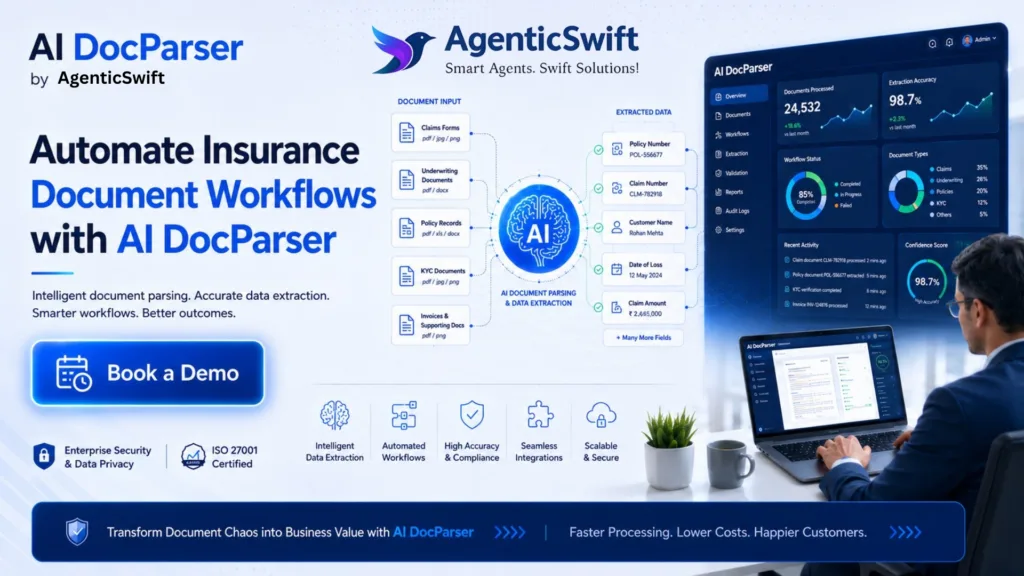
AI Doc Parser by AgenticSwift can extract fields such as names, dates, totals, and compliance data from diverse document types.
Intelligent Classification
It can automatically categorize documents based on content, format, and context, which is critical for claims, policy operations, underwriting submissions, and onboarding workflows.
Scalable Processing
It can process large volumes of documents, which is important for insurance teams handling high-volume intake and servicing queues.
Seamless Integration
AI Doc Parser by AgenticSwift is designed to integrate with ERP, CRM, and data management systems for end-to-end automation, which supports practical implementation rather than isolated parsing.
Business Relevance Across Functions
It is adaptable across operations, compliance, customer onboarding, claims processing, and policy administration, making it suitable for multiple insurance workflows.
In simple terms, insurers do not need a parser that only reads documents. They need a parser that helps move business workflows forward. That is the commercial opportunity behind AI Document Parser by AgenticSwift.
Benefits of AI Document Parsing for Insurance Companies
The use cases above lead to business outcomes that insurance decision-makers care about.
Faster Turnaround
AI reduces the time spent reading, sorting, and extracting information from documents, helping teams move faster across underwriting, onboarding, and claims.
Better Operational Efficiency
High-volume document work becomes more manageable when teams no longer need to copy data manually from one file into multiple systems.
Improved Accuracy
Structured extraction and classification reduce common human errors in indexing, data entry, and document handling.
Stronger Fraud and Compliance Support
When claim and compliance documents are structured properly, fraud systems and audit teams can work more effectively.
Better Customer Experience
Faster claims intake, quicker onboarding, and smoother servicing workflows translate into a better experience for policyholders, brokers, and internal teams.
Why Insurance Companies Should Invest in AI Document Parsing Now
Insurance companies are under constant pressure to improve operational efficiency, reduce claims delays, enhance customer experience, and manage compliance more effectively. At the same time, the volume and complexity of documents keep increasing.
That is why investing in AI document parsing is no longer just a technology upgrade. It is an operational strategy.
With the right solution, insurers can reduce manual effort across multiple departments, improve processing accuracy, and create a more scalable document workflow. This is especially important for businesses that are growing fast or already dealing with high volumes of policy, claims, and onboarding paperwork.
For insurers evaluating document automation tools, the real question is whether AI can help. The real question is how quickly they can implement a solution that fits their workflows and delivers measurable value. That is where AI Document Parser by AgenticSwift becomes relevant.
Final Thoughts
The best use of AI document parsing in the insurance industry is not just scanning files faster. It is creating a more efficient, more accurate, and more scalable insurance operation.
From underwriting automation and insurance KYC verification to policy document automation, claims intake, and fraud detection support, the use cases are clear. Insurance companies that still depend heavily on manual document review are likely losing time, increasing operational cost, and slowing down customer-facing processes that could be streamlined.
That is where AgenticSwift’s AI Doc Parser becomes commercially relevant.
AgenticSwift AI Doc Parser is not positioned as a generic OCR tool, rather it is an ICR(Intelligent Character Reading). The ICR, AI Document Parser built to read, extract, classify, and process complex business documents at scale while integrating with enterprise systems. For insurers, that means a practical path to automating document-heavy workflows without losing control over accuracy, speed, or business context.
If your insurance business is handling high volumes of submissions, KYC files, policy records, or claim documents, AI document parsing is no longer a nice-to-have. It is becoming part of the operational foundation for better insurance automation.
FAQ’s
How is AI used in underwriting?
AI is used in underwriting to automate submission intake, summarize documents, extract risk-related data, and support faster triage so underwriters can focus more on decision-making rather than manual paperwork.
Can AI verify documents?
AI can help verify documents by extracting data, checking completeness, identifying mismatches, and supporting document validation workflows, though exception cases may still require human review.
What is KYC automation?
KYC automation is the use of AI and workflow tools to collect, read, validate, and process customer identity and compliance documents more efficiently during onboarding and policy issuance.
How does AI detect fraud in insurance?
AI helps detect fraud by analyzing claims-related data, documents, text, images, and patterns for anomalies, inconsistencies, and suspicious behavior that may indicate fraudulent activity.
What is AI document parsing in insurance?
AI document parsing in insurance means using AI to read insurance documents, extract key information, classify document types, and convert unstructured files into structured data for business workflows.
What insurance documents can AgenticSwift’s AI Doc Parser help process?
AI Doc Parser by AgenticSwift can support complex business documents and compliance-heavy workflows, which makes it relevant for policy documents, onboarding files, insurance forms, claims-related records, invoices, and other operational documents.
Why do insurance companies need AI document parsing?
Insurance companies need AI document parsing to reduce manual processing, improve accuracy, speed up underwriting and claims workflows, support fraud detection, and handle large document volumes more efficiently.
Looking to Automate Insurance Document Workflows?
If your team is spending too much time on policy documents, KYC files, underwriting submissions, or claims paperwork, AI Doc Parser by AgenticSwift can help you extract, classify, and process insurance documents faster with less manual effort.
Book a demo of AgenticSwift’s AI Doc Parser to see how AI document parsing can support insurance automation across underwriting, claims, onboarding, servicing, and compliance workflows.